Showing posts with label Wild food foraging. Show all posts

Wednesday, August 8, 2012

Invasive Species: Eat Them Before They Eat Everything


Article and photo from CNN.com Eatocracy:
A growing number of conservationists are advocating the consumption of invasive species in an effort to fend off environmental destruction.
Invasive species, as defined by the USDA’s National Agricultural Library, aren't native to the local ecosystem and may cause economic, environmental or medical harm. They can exist in many forms: plants, animals or even microorganisms.
Many of the invasive plants, such as dandelion and purslane, were originally introduced by settlers for medicinal or ornamental reasons, while many of theinvasive animals like Asian carp and green iguanas were brought in as food sources, pets or for pest control.

Mongooses, one example, were originally imported from Southeast Asia to control rodent and snake populations in Caribbean and Hawaiian agricultural fields.  The Hawaii Invasive Species Partnerships has since estimated that the species causes $50 million in damages each year in Puerto Rico and Hawaii alone.
From feral hogs running wild in Texas to lionfish eating their way through the Gulf of Mexico to kudzu, whose nickname “the vine that ate the South” speaks for itself, the United States is facing an invasion of the natural resource snatchers.
While kudzu may have swallowed up the South, conservationists and food activists are encouraging American consumers to bite back.
“Why not combine the growing locavore movement with an ecological awareness and try and reduce some of these species?” says Joe Roman, conservation biologist, author and editor of EatTheInvaders.org. “It’s unlikely we’re ever going to eat them to extinction but we can reduce the numbers that are there and also get an excellent meal.”
Because these species typically won’t encounter natural predators, it’s primarily up to humans to control or remove the invaders. Some managerial methods involve mechanical control, like digging or mowing, or chemical control, like pesticides and herbicides. Or, people could eat them.
There are, of course, major hurdles with upping the consumption of invasive species. For one, most could use an image overhaul.
“Here in America, we’ve raised two generations of consumers to think that only luxury cut from the center of the animal is what we should eat,” says Andrew Zimmern, the host of “Bizarre Foods” on the Travel Channel. “And only from three or four animals, I might add.”
Nutria, for example, is a giant water-born rodent – but many chefs compare the taste to that of a succulent rabbit. It’s all about consumer perception.
“You start to stretch our food imagination, we can take it in sorts of great directions,” says Zimmern.
“Think of a species that now shows up on menus that people wouldn’t have dreamed of eating maybe a decade or two ago. There is certainly an ‘ick factor’ we’re going to have to get over to promote this,” says Roman.
Chef Bun Lai, at his restaurant Miya’s in New Haven, Connecticut, actively pursues this sort of rebranding.
Miya’s offers an invasive species menu, with ingredients like European green crabs, lionfish, knotweed and wild swans, that threaten the local ecosystems.
“We hope that this will do a few things. First of all, it could potentially curb the dominance of invasive species in the ecosystem. Secondly, it would provide the seafood industry a greater supply of native seafood and reduce the stresses on those populations already fished,” Lai explains on the restaurant’s website. “Finally, we hope that it would encourage greater balance in the inter-regenerative relationship between man and the oceans.”
As with any strategy though, there are always risks. First, not all invasive species are safe for human consumption. Providing educational resources about how to prepare certain species (for lionfish, remove the poisonous spines) and what is and is not safe to forage is crucial.
Secondly, marketing an invasive species could encourage less scrupulous entrepreneurs to move these species where they didn’t already exist because they are potentially lucrative, Roman says. That could easily backfire and spread the species’ destruction even further.
Then, there are concerns of depleting the population, which Zimmern adds, wouldn’t be a bad thing because, after all, they’re not naturally supposed to be there.
“Let’s get to the point where they’re extinct or nearly extinct and then they’re a manageable resource. Let’s farm them, let’s do other things with it, but we can’t just let these invasive species be out in the wild,” he says.
Although population control is obviously at the forefront of the invasive species battle and consumer appeal is only part of the invasive solution, Zimmern says there is another opportunity: take them out of the ecosystem and find a way to feed hungry people.
“The biggest problem with the invasive species argument - in terms of not eating them - is people are hungry, these are good foods,” he says.
With protein’s high expense and one in six people living in hunger, Zimmern advocates in collecting invasive species and using that meat to feed children, seniors, people in the jail system and other people living below the poverty line.
“I will tell you right now, as someone that’s had a bologna sandwich in jail, I would prefer to eat nutria every day of the week,” he says.
Spaghetti and Periwinkles (Snails)
Serves 4 to 6
Used with permission from EatTheInvaders.org
About 2 cups of periwinkles in shells
3 cloves garlic
1 teaspoon dried parsley
1 tablespoon olive oil
3 cups plum tomatoes from the garden, or a 20 oz. can of imported Italian plum tomatoes
Salt and pepper to taste
1 pound spaghetti
Grated Parmesan cheese
Italian bread
Wash the snails in cold water. Add periwinkles to a pot of boiling water, along with a small handful of salt to shrink and toughen the meat. (This eases their removal.) The snails are ready when the operculum falls off.
Remove the periwinkles from their shells with a nutpick or pin. (This can be time consuming, find an assistant if you can.)
Sauté garlic in olive oil. Add parsley and tomatoes, and cook for about 30 minutes.
Boil four quarts of water. Add spaghetti, and remove when soft but still firm to the bite. At the same time that you add the spaghetti, add the periwinkles to the sauce.
Mix the pasta and sauce in a warm bowl. Serve hot, with crusty Italian bread and grated Parmesan cheese.

Friday, April 13, 2012

Wolfberry: the Wild Gogi Berry

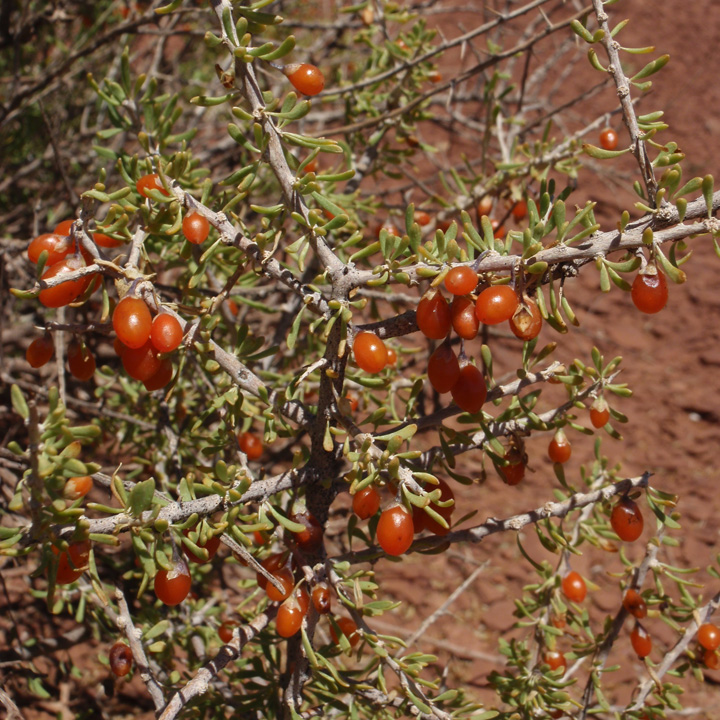
Ripe Wolfberry
Gogi berries have been quite the rage for the past few years as a sort of super food.  I am sure the berries are very healthy but there really isn't any scientific support for them as a super food at this time.  At a minimum though they are just as healthy as any other berry, which other berries are indeed very healthy.  Here in the Sonoran Desert Wolfberry is quite common, especially along dry washes.  Between now and the  middle of May is when they are ripe for harvesting, and they are quite easy to find.  They look like miniature tomatoes that grow on medium to small sized bushes.  The resemblance is for good reason, both Wolfberry and tomato are in the same plant family, specifically the genus Lycium.  They sure don't taste like tomatoes though, but probably closer to a raspberry.  The amazing thing about Wolfberries is that their size varies significantly from year to year depending on timing and amount of rain received during the winter months.  Years with little rainfall will yield tiny berries that are not worth picking.  Years with more rainfall will yield nice sized berries slightly smaller than a raspberry.  This year I have noticed that Wolfberries along washes are niced sized while those outside of washes are too tiny to pick.

Anyway, its the right time of year to search out this berry along desert washes.  Be sure to bring a good plant identification key so you can be sure to correctly identify what to pick and not to pick.  The best way is to identify the plant by leaves, berries, and the flowers.  Unfortunately, the small purple flowers have been gone since February.  In future years though, consider searching out the plant by flower in February, then remembering its location come back to harvest berries in April.  My guess is that these wild gogi berries are healthier than what you can buy in the store, if for no other reason other than the fact that you have to hike around to find them.
Wolfberries small purple flowers, usually found in February.

Monday, March 26, 2012

The Science of Fishing

Bluegill.
Fishing may not seem like an extremely scientific activity, but in reality it can be extremely scientific.  When fishing you have to take into consideration the basic food chain, fish as well as bait behavior, and the local ecology.  For example, I grew up fly fishing for trout and learned a lot about all of the above.  Trout are towards the top of the food chain in a stream and mostly feed on small aquatic insects such as scuds, may flies, and caddis flies.   Every region and every stream has their own specific set of aquatic bugs.  So a basic knowledge of what types of bugs are in a certain stream will automatically give you a huge advantage towards a successful fishing trip.  You can easily identify the aquatic bugs of an area simply by picking-up rocks off the bottom of a lake or stream and seeing what bugs are crawling around on them.  Secondly, certain bugs are only active at certain times of the year and therefore fed on by fish at certain times of the year.  These bugs can be found simply by looking for what bugs are swimming around in the water or floating on top. 

A lot of fish behavior will be determined also by bug behavior as well as habitat.  I have found that in many trout streams bugs are most active during the middle part of the day and therefore trout are also most active during the middle of the day, making it the best time to fish.  Bass and bluegill though seem to be most active early in the morning or late in the evening, making those the best times to fish for these species.  As for habitat, nearly all fish like some sort of cover whether its a pile of rocks, weeds, or an over hanging bank making these the best areas to fish. 
Rainbow Trout.
But whatever you are fishing for, a little background knowledge can go a long ways.  Research and try to find out 1. what is available for the fish to eat at that time of the year (that is what lure or bait to use), 2. how is that food behaving or how can you get the fish to eat it (how to retrieve the bait or lure), 3. where should I place my lure or bait (in the current, next to the current, by a bank over hang, next to weeds...).  Looking at fishing this way make it a little more complex then just casting a worm out there and waiting.  But it can also make the whole experience a lot more educational, interesting and successful.  I definitely enjoy fishing a lot more when I look at the trip in this way.  With more fishing trips and more observations you should become more successful.  There is one additional guideline: whatever works for you use it, even if it breaks the above three guidelines.

Monday, December 5, 2011

Louisiana Wetlands and the Mississippi River Delta Part 2

A floating Louisiana marshland.  This wetland is characterized by thick mats of semi-floating grasses, sedges, rushes, and a few small shrubs and are important to alligators for hibernation   
Also within these areas is the famed alligator of the south.  The abundance of water and bird life of these swamps and marshes feed these gators, allowing them to grow to large sizes.  The wild gator grows about one foot a year until it reaches six feet, then growth slows considerably.  The longest lived gators can survive up to 90 years in extremely rare instances and reach 15 feet in length.  Gators over six feet are uncommon but gators less than this are often found in abundance.   During warm summer months when water temperatures are over 70 degrees gators can be found throughout the swamps and marshes, anywhere there is enough water.  However, in November water temperatures drop below 70 degrees and gators go into hibernation until early spring when the water warms up again.  Typically, water levels in these wetlands fluctuate with ocean tides and floods coming from upstream.  This is a problem for hibernating gators who need to hibernate in wet areas but cannot be submerged with flood waters.  Because of this, gators hibernate in floating grassy marshlands that float up and down with fluctuating water levels.  Gator hunting is a rather common practice in Southern Louisiana.  The game management agency allows one gator to be harvested per twenty acres of wetland.  I've been told this is a major meat source for rural Louisianans.  I personally have eaten gator fried, as jerky, and as sausage.  Fried gator is rather chewy, but the jerky and sausage are great.  I love both of them.  In-fact, I may like gator jerky better than beef jerky.
A Louisiana alligator found in a bayou.  
Underneath all these wetlands in the sediments is an abundance of oil and natural gas.  Over past decades these natural resources have been drilled and mined out of the sediments, resulting in the wetlands sinking and flooding with more water.  This flooding has killed wetland vegetation and caused the disappearance of  this habitat.  According to some sources an entire football field of Louisiana wetland is disappearing as a result of this every 38 minutes.  Historically, the Mississippi has also snaked its way back and forth across southern Louisiana depositing sediments in low laying areas everywhere it went.  Today, the Mississippi is highly channelized and controlled by the Army Corps of Engineers, preventing this nature controlled movement and deposition of the river.  So when wetlands sink, sediments from the river is not available to raise them back up again.  People from all professions and industries are still searching for solutions to this problem.

The red area of the ocean indicates areas of low oxygen known as the dead zone.  This dead zone is a result of  water pollution brought into the gulf by the Mississippi River.  Picture from Wikipedia.
As the muddy waters of the Mississippi pass through the Midwest and the South, some of the richest agricultural land in the world, sediments and fertilizer are washed into and pollute the river.  The vast wetlands of the Mississippi River delta capture much of this pollution.  As wetlands naturally do, they capture and filter out pollutants from water in an amazingly efficient manner.  However, as some of these wetlands disappear, and being the levels of pollution are so extremely high, much of the pollution works its way through the delta and is deposited into the Gulf of Mexico.  This immediately has the effect of "fertilizing" the Gulf, which may seem a good thing at first.  Fertilization of water by pollution is known as eutrophication, and results in large algal blooms.  Once this algae dies however, the decompose and consume all the available oxygen in the water.  As a result of these low oxygen levels, very little ocean life can survive in these areas, giving it the name "dead zone."  The dead zone in the Gulf where the Mississippi ends currently is the size of New Jersey and has had huge effects on sea life, including the fishing industry.
Sediment pollution causing the dead zone (right side) next to oxygenated waters (left side).
Despite the negative, the wetlands of Southern Louisiana are still a vast, amazing, and relatively healthy functioning ecosystem.  Even in their impaired state these wetlands are still intact and functioning as they should.  Of course, they could function better if the Mississippi was allowed to flow as it pleased rather than be controlled.  With the many towns and small settlements in the area, letting the Mississippi flow back and fourth across the delta would likely destroy many of these communities.  Controlling the Mississippi is also important to the shipping industry.  So simply restoring natural flow is not such as simple task.  Still, even in their present state these wetlands absorb and filter much of the pollution that is carried down the Mississippi as well as provide huge areas for wildlife and recreation.  Without these functions the current dead zone in the gulf would be much larger and have enormous impacts on the fishing industry.

While I was only able to spend one day exploring these wetlands, it made me hungry to experience them more.  These wetlands are an amazing place to which so many people, cultures, plants, birds, and animals call home.  All of these different aspects are tied together forming the diversely rich creole culture.  In the near future, I will be talking more about this creole culture with a post about a historic Mississippi river plantation.

Friday, December 2, 2011

Louisiana Wetlands and the Mississippi River Delta Part 1

A Louisiana bayou in the Mississippi River Delta.  
Louisiana boasts an amazing 40 to 45 percent of the continental United States wetlands.  Flying into, and driving through Southern Louisiana gives you a good sense of the vastness of these wetlands, miles and miles of unbroken soggy earth everywhere.  Water is literally everywhere, there is of course lots of open water, and where there isn't open water there are sopping wet grassy marshes, and where there aren't mashes their are soaked forests.  The air is always full of humidity with a faint marshy smell, no matter where you are at.  I have visited many wetlands in my life, but none compare to the expansiveness and diversity of these subtropical wetlands.

A part from the sopping wet nature of southern Louisiana, the next most obvious feature is the perfectly flat nature of this landscape.  This soaked flat landscape is a result of the Mississippi River reaching the Gulf of Mexico and depositing massive amounts of water and sediment as the river slows before dumping into the ocean.  The Mississippi begins as a small clear stream at Lake Itasca in Northern Minnesota, which I have personally walked across in only a few short steps that only went up to my knees.  Growing up, I also fished the Mississippi River in Iowa where it is a mighty and muddy river.  Flowing southward, the river continues to grow in volume and accumulate more muddy sediments making it "The Big Muddy."  All this water and mud however has to end up somewhere and is deposited in a delta entering the Gulf of Mexico in southern Louisiana.  This deposition and delta forming process has been taking place for thousands of years since the end of the last ice age.  The entirety of Southern Louisiana was at one time deposited by the Mississippi, and today, over one mile of sediment covers the underlying bedrock.
Oak trees draped with Spanish Moss along a higher, drier portion on a bayou.
Along the Mississippi and other distributary rivers flowing out of it, heavier sandy sediments are deposited along the bank.  These sediments form a sort of natural levee elevated above the rest of the alluvial plain.  On these natural levees many species of oaks are commonly found including the Southern Live Oak, Water Oak, and Swamp Laurel Oak.  These Oaks can only tolerate temporary flooding and need to be on dry land adjacent to lots of water, such as next to a river or swamp.  A short distance from the river, the natural levee slopes slowly down, away from the river.  As the slope moves downward, away from the river, the ground becomes increasingly wet.  Maples and Ash grow on this wetter back-slope along with some oaks.  Lower on the back-slope the ground becomes increasingly saturated, often with standing water, here Baldcypress and Water Tupelo grow.  These areas are still high enough on the slope so that they are not flooded for extended periods of time.  Cypress trees can grow for over 1000 years on these sites and grow large "buttress" roots around the base of their stump in order to stabilize themselves for these long periods of time in these soggy loose soils.  All of these trees are draped with often thick clumps of Spanish Moss.  This moss, is technically not a moss at all but rather more closely related to a pineapple, very odd considering they look nothing alike.  These draperies of Spanish Moss are normally tan colored, except for after rainfall when they turn green.  Hanging from trees and blowing in the wind the moss gives the narrow bayous a romantic southern feel, as they decorate the majestic oaks and cypress trees.
Baldcypress trees found in wetter portions of the wetland then the oaks.  
A floating marsh wetland characterized by grasses, sedges, and rushes.  These types of marshes are important locations for alligator hibernation.

Away from the natural levee and closer to the mouth of the river where the water is always flooded, floating marshlands exist which are dominated by grasses, rushes, sedges, and cattails.  Historically, these floating marshes were far more common and widespread.  As they were settled, channels were dug through these marshes and the sediments piled adjacent to the channel.  These new channels formed what are known today as bayous with the adjacent piles of sediments forming vegetation similar to the natural levees along rivers.  These marshes and bayous can have brackish water (slightly salty) or freshwater and are filled with an abundance of life.  Brackish waters have crabs, while crayfish are found in fresh, both of which are trapped for the great seafood the area is known for.  Bass, crappies, drum, gar, and catfish are in abundance in these areas.  A guide told me there are so many fish in these wetlands that if you don't catch any fish, you don't tell anyone.  In other words, there are always fish to be caught, and to not catch any is not typical, and embarrassing.  Birds also fill these areas including waterfowl of all types, herons, and ibis.

This concludes part one of the Louisiana Wetlands.  In our next entry we will cover the famous alligator of these wetlands as well as some of the ecological issues they face today.  

Thursday, November 24, 2011

Happy Thanksgiving!!!


Happy Thanksgiving!  Here on the Practical Biology Blog we try to take a biological perspective on things, turning the ordinary into interesting biological education.  And of course, eating is biology, so Thanksgiving is an easy lesson in biology.  What we consider today as a traditional Thanksgiving meal really is no reflection of what the original Thanksgiving meal looked like.  If we do our history, however, we can come pretty close to figuring out what the original 1621 Thanksgiving meal looked like at Plymouth.  History tells us that the original Pilgrims, especially during their first year in the New World, were primarily farmers, gardeners, hunters, and gatherers.  Some of these skills, such as gardening and farming, they would have learned in England.  Most of them they would have had to learn from the Native Americans.  Even skills they learned in the Old World would have had to be relearned in the context of the new conditions in America.  

A little more history.  When the original Pilgrims landed in Plymouth in 1620 they barely survive the winter.  If it were not for them finding a large stash of hidden corn in an abandoned Wampanag Native American village they all might have died.  I must add here, the Pilgrims were a peaceful Christian people, they did not kill the Native Americans and did not steal their food.  In the year to come the Pilgrims and Wampanag people developed a peaceful relationship through which the Pilgrims learned much about how to survive in the New World.  Remember at this point, the New World was nothing like it is today.  In 1620 and 21 the New World was a very hostile place to Europeans.  The winter was far harsher then anything they had encountered, there were no markets for food or established agricultural system, no stores for supplies or tools, no houses, and no buildings.  It was pretty much what we would consider wilderness and everything they needed had to come from the land or the little they carried over from England.  These Pilgrims had no clue how to survive with meager supplies in a wilderness they had never encountered before.

So that first year was extremely difficult.  In-fact, it was so difficult that normally modestly dressed Christian Pilgrims were described as being dressed in rags or nearly naked.  They had virtually nothing that first year.  But after a peaceful relationship with the Wampanag people was developed they began to learn how to hunt, fish, trap, grow food, and gather food from the forest plants.  During that first year, the Pilgrims learned to live on the land so well that by fall they had an abundance of food.  During that first year they went from having next to nothing and no real idea of how to survive to learning how to survive and having an abundance of food.  Anything could have easily wiped the entire Pilgrim group out during that first year but it didn’t, and they did as every good Christian should, they thanked God.  A big part of this thankfulness took place with a three day celebration full of food, games, and just having a thankful good time among themselves and the Native Americans they befriended.  This celebration became known later as the first Thanksgiving.

So the first Thanksgiving meal would have been composed of food items grown and gathered by hand, not bought from a store.  The meal also would have been heavily Native American influenced being that is who taught them how to gather their food.  Some of you may be wondering at this point, what does all this have to do with biology?  Much in every way.  Of course gardening is biology as well as living off the land.  All of this had its context in the Eastern Deciduous Forest ecosystem of New England.  So all of the plants and animals they gathered would have only come from the local environment.  We do know the Wapanag people contributed five deer to the first Thanksgiving.  The Pilgrims also hunted a huge number of what they called fowl.  Fowl likely was duck, goose, turkey, and other birds.  Other than that we really don’t know exactly what was on that first menu.  We can take clues from the local environment of what probably was on that menu through.  It is also very likely that they ate eel, lobster, mussels, and fish.  As for plant products there were also probably nuts such as acorns, walnuts, hickory nuts, and chestnuts.  Fruits and berries gathered from the forest would have been out of season during the late fall when the celebration took place.  There would have also been an abundance of garden produce including squash, pumpkin, corn, leeks, carrots, parsnips, cabbage, and turnips.  Some of these plants were given to them by the Native Americans while others would have been brought over as seed from Europe.  Also interesting is that the corn would not have been sweet corn, it would have been ground up and served as cornbread, mush or pudding.  There was also very little or more likely no sugar.  So no sweet desserts except for what could have been sweetened with molasses.  No pies, no cranberry sauce, and no sweet potatoes with marsh mellows on top.  Maybe a little wine and beer but most likely only water (The Pilgrims didn’t have a problem with moderate consumption of alcohol).  

If you think about it, this would be quite an interesting meal.  I mean, who wouldn’t want lobster and eel for lunch three days in a row! Have a happy Thanksgiving!

Thursday, November 3, 2011

Simply Unique Seaweed


Seaweed is one of the simplest, most unique, and interesting plants.  But calling seaweed a plant is a slight misconception.  Technically, seaweed is not like the land plants we commonly encounter, seaweed is actually an algae.  What's the difference between plants and algae?  Land plants are much more complex, they absorb nutrients and water through extensive root systems, and have vascular systems to distribute these through out the plant.  Algae on the other hand have no root system, instead they have a holdfast, which simply anchors them to the ocean floor.  Instead of a stem, algae have a stipe, which is like a stem but does not contain woody vascular tissue.  Lastly, algae may have what looks like leaves but actually are called lamina because they also lack vascular tissue.  Nutrients, instead of being absorbed from the soil, through the roots, and then transported to the leaves through the stem like land plants, algae directly absorb everything they need directly from the ocean.  Nutrients move from the ocean directly into lamina where it feeds the algae.  One major function land plants and algae have in common though is both harvest light using photosynthesis to produce sugar for energy.

All kinds of algae grow throughout the ocean, the largest and most interesting grow in the tidal zone.  These are distributed by elevation within or near the tidal zone.  Some species are located just above the tidal zone gaining nutrients from wave spray or splash.  Other species only like to be covered with with water for a short time each day so are in the highest portion of the tidal zone.  Others like weak waves and others very strong waves.  Each has their specific preference of conditions.  The largest are the furthest out from shore.  Bull Kelp, for example, can grow in water 100 feet deep with their highest lamina floating on the surface.  Kelp grows with amazing speeds of up to 20 inches in one day during the summer.
An underwater kelp forest.
The following video is great, showing how seaweed is harvested and the type of environment it is typically found it.  I have spent a decent amount of time in tidal areas like this and they are truly amazing places.  Typically, places like these are only accessible during low tide.  A few locations where deeper water algae grow may only be accessible during the lowest low tides which only happen a few days a month or a few days a year.  The waves, ocean, rocks, and great abundance of sea life in these areas is both beautiful and amazing.  At the same time these areas are extremely dangerous and only highly skilled and informed people can experience these areas on a relatively safe basis.  I say relatively because the constantly pounding waves, the rocks, and currents can be quite unpredictable, even to the most experienced.  Larch Hanson, the person harvesting the seaweed, is amazing at how he handles this dangerous environment, making it appear quite easy.


The Perennial Plate Episode 76: Seaweed Man from Daniel Klein on Vimeo.

Seaweed is truly remarkable for the number of things it can be used for.  Of course, most people know that sushi is wrapped in seaweed, specifically Porphyra.  Seaweed salads available in Japanese restaurants are typically made from Wakame.  Agar and other gelatinous materials are also produced from a variety of different alga.  It is also an excellent source of many different nutrients that are not typically present in other foods, but especially iodine.  This great diversity of available nutrients also makes it an excellent organic fertilizer.  Research is also being done on how to efficiently use seaweed to produce bio-fuels.  This all makes for a booming but relatively small seaweed agricultural industry that is still in its infancy having only started about 50 or so years ago.

More information on seaweed: Maine Seaweed: the Seaweed Man

Friday, September 9, 2011

Mushroom Hunting


The Perennial Plate Episode 69: Mountain Morels from Daniel Klein on Vimeo.

While I'm not much of a mushroom hunter, I sure would like to be.  Being the desert is about the worst possible place for mushroom hunting I'm sort of out of luck.  Arizona's higher elevations do offer some decent mushroom hunting.  Outside of the desert though, mushroom hunting is an excellent way to get outside and learn about all kinds of things in the outdoors.  Anyone can do it just make sure you have the right field guides for identifying mushrooms and go along with someone that is experienced.  You can learn all sorts of ecological secrets in the process of mushroom foraging.  Of course, never eat something that you aren't absolutely sure of what it is.  For most of North America Morel season is months behind us but for more northern and mountainous regions they can be found in abundance as seen in this video.  This is episode 69 of the Perennial Plate and is filled with interesting ecological facts about Morels as well as great mountain views.  The Perennial Plate also has a great website with weekly videos and blog entries.

Sunday, August 14, 2011

Prickly Pear Fruit Harvesting and Natural History

Prickly Pear cactus with ripe fruits.  
End of July through August tasty tunas ripen all over the Sonoran Desert.  Tunas in the desert you may ask?  Tunas are simply a common name utilized for Prickly Pear fruit in the Southwest, actually having nothing to do with the fish and are much sweeter.  After blooming in spring, a green fruit appears at the base of the flower.  After months of ripening through blazing summer heat, the green fruit turns pink, then red, and finally a dark red wine color.  Once fruits are red, they are ready for picking but flavor can change considerably as the color changes.  After ripening, if the fruit is not eaten it simply dries up and falls to the ground.  Prickly Pear is most abundant in areas receiving greater than eight inches of rain annually and where much of this rain comes in summer.  Mountainous areas in the eastern Sonoran Desert, such as west of Phoenix and around Tucson, can have huge thickets of Prickly Pears often blanketing the landscape in places.  The number of fruits a plant produces annually depends on how much rain was received during winter months.  However, even in average rainfall years, so many fruits are produced even the animals will not be able to eat them all.  Luckily, these fruits keep for a month or so on the plant.  Even then, most of the fruits will not be eaten.
Desert Tulip Prickly Pear flower blooming in April (Opuntia phaeacantha)
As with all fruits, fruits are meant to be eaten.  The Prickly Pear produces brightly colored sweet fruits, attracting birds of many types as well as Javelina, Deer, Chipmunks, Coyotes, Kit Fox, Pack Rats and just about any other desert dwelling animal, including humans!  All cacti produce a brightly colored fruit with seeds filling the pulp inside.  Most cacti, such as Saguaros, produce tiny black seeds that are highly adapted to being eaten by birds.  Prickly Pears, however, contain tan seeds, many times larger that are as hard as rocks.  Oddly, if you were to simply to plant one, water it, and wait for it to grow, nothing would probably happen.  These rock hard seeds are rock hard for a reason.  They are designed to be eaten by animals and have their seed coat partially digested, making them ready for germination.

In Mexico, South America, and the Mediterranean region domestic Prickly Pears are cultivated for both their pads and fruit.  Depending on the variety, large red, green, yellow, or orange fruits can be produced.  In the wild however, red is the only edible fruit color.  Many different species produce edible fruits, but in the Sonoran Desert Engelmann's and the Desert Tulip Prickly Pears (Opuntia engelmannii and phaeacantha) are probably the most abundant that produce edible fruits.  Many species produce inedible fruits, but they aren't poisonous, the fruits simply dry out before they can be eaten.  Native Americans generally did not eat too many fruits at one time however, being too many fruits can produce a fever for some unknown reason.  The same is true today, if you eat wild prickly pear fruit don't eat too many, or you likely will be running a fever.  The fruits are extremely tasty and refreshing, something like a cross between strawberry and watermelon.

How to Harvest Prickly Pear Fruit
1.  Find a Prickly Pear cactus with red fruits on it during the months of July or August.  Fruits will taste different depending on their color, species, location, and time of day harvested.  Experiment and find what tastes best to you, but don't worry about it, if ripe they all taste pretty darn good.
2. Using a grill tongs pick the fruit off the cactus.  The tongs will help you avoid being poked by the spines.  A few dozen fruits will be plenty to start.
3. Freeze the fruits for several days.  This burst the cells containing the juice.
4. Thaw out the fruits and then mash them in a bowl.
5. Once the fruits are mashed, strain out the juice into another container.
6. This juice should be boiled and can be used for a variety of different recipes.  I simply like to drink some of it.

Another version of the above is to place the fruits in water and boil.  Boiling, like freezing, bursts cells releasing the juice.  After boiling, mash the fruits and strain out the juice.

Website with Prickly Pear fruit recipes: http://www.cooks.com/rec/search/0,1-0,prickly_pear,FF.html

Tuesday, July 12, 2011

Midwestern Eastern Deciduous Forest summer

Late spring (mid-May) in the Eastern Deciduous Forest at Indian Creek Nature Center near Cedar Rapids, Iowa.  Notice how sunny the forest floor is due to the trees not being entirely leafed out.
Summer (late June) in nearly the same location at the Indian Creek Nature Center as the  picture above.  Notice the forest is much darker due to the trees being leafed out.  Not so noticeable in this picture is the thicker summer vegetation.
Summer in the eastern deciduous hardwood forest is quite different from the spring.  Spring can be cool and wet with plenty of sunshine hitting the forest floor (click here for a post on the spring forest).  Come June though, the trees have completely leaved out and the once sunny forest floor can become quite shady, often with only about 5% of sun hits the forest floor.  Spring forest wildflowers disappear and are succeeded by a thicket of more heat and shade tolerant herbaceous plants. While spring forbes can be quite pleasant and easy to hike through, summer forbes are a lot more itchy and on the defense.  Plants like Stinging Nettles and Poison Ivy are extremely abundant and can make a short hike quite painful.  The mosquitoes can also add to this pain and humid warm air (typically in the 80's) can also make this a sweaty experience.  Enough of the negative though!  The forest is quite a refuge from the summer heat and sun.

While the summer forest can be quite itchy,It is quite a refuge from the summer heat and sun.  It is also one of the most wondrous and active habitats around.  If I were to describe the summer forest in one word it would simply be GREEN.  Absolutely everything is beautifully green.  The forest floor is green with mosses and a thick layer of bushes and leafy plants.  Above, smaller understory trees like elms, dogwoods, and ironwoods are green.  Towering higher, canopy trees like oaks, maples, walnuts, ash and hickory's form another thick green layer.  Each of these layers of green is also full of life, which can often be difficult to see due to thick vegetation.  Birds of all types, Cardinals, Indigo Buntings, Cat Birds, Turkeys, Warblers, Gnat Catchers, Ducks among many others fly through out the layers of vegetation and fill the woods with songs all day long.  Whitetail deer, rabbits, and squirrels also abound.

The forest floor as well as the understory are also full of berries this time of year.  Black Raspberries, Dogwood Berries, Mulberries, Chokecherries, and Goose Berries are quite an abundant food supply for forest life or the hiker who can positively identify the plants.  These plants produce their fruit in hopes that some passing animal will eat them and carry the seeds to new locations.

Chokecherries
Goose Berries
Black Raspberries
All of this greenness and abundant berry production continues until fall when the weather cools off and drys out.  Once berry production ends, an abundance of nuts that grow on trees throughout summer, including acorns, walnuts, and hickory nuts, ripen and fall off the trees.  But until then, forest life has plenty of time to gather the abundance of the summer forest and relax in the shade until fall and winter when things become harsher.

Thursday, June 30, 2011

Mesquite natural history and bean pod harvest

A Sonoran Desert Mesquite Bosque made up of Velvet Mesquite (Prosopis velutina).
Starting towards the end of June and through mid-August or so, Mesquite (Prosopis sp.) bean pods are ripe for harvesting in and around the Sonoran Desert.  Once the pods are tan colored and dry they are ripe.  The pods have two parts; the seed portion and the pod.  Both can be edible.  The seed portion is a bean which is as hard as a rock. By itself it is not digestible unless it is ground up.  The pod part is edible and has an earthy sweet taste.  All kinds of desert animals such as deer, cows, javelina, rats, and others consume the bean pod along with the bean.  The pod provides nutrition for the animal but the bean passes unharmed through the animal.  As the bean is passing through the digestive tract is absorbs moisture, may be partially scarified, and is finally deposited in a warm moist pile of dung.  All of this can greatly aid seed germination and survival of the seedling.  Animals also provide the extra bonus of carrying the seeds to new locations as they pass through the digestive tracts.

Velvet Mesquite bean pods ripe for harvesting mid-June in the Sonoran Desert.
While none of this is pretty, it is pretty darn effective.  In the absence of fire and/or other biological controls that scientists don't exactly understand, this method of seed transportation and deposition has at least partially caused the spread of mesquite trees all over the southwest.  Mesquites were once widely interspersed in desert grasslands and limited to wet areas where they would form dense "forests" called bosques.  In the present day they have invaded desert grasslands, often forming nearly impenetrable thickets.  Once these thickets are established, only fire, herbicides, or mechanical removal of them can return the grassland to an open state.  These treatments, particularly fire, are most effective before the mesquites become too large.  It is extremely difficult, if not nearly impossible, to remove an established mesquite thicket.

When the pods are dry and tan they are also ready for people to harvest them for eating.  The whole process can be quite easy for someone willing to brave the heat.  Simply find a tree with tan dry pods and pull them off the tree.  Some trees will produce sweeter tasting pods then others.  Simply break some pods and chew on them to see if you like the taste or not.  Collect pods from trees that taste favorable to you.  Mesquite pod collecting is legal on certain public lands such as Forest Service and BLM lands but not on National Park or preserve lands.  Private land is legal if you have permission.  Make sure you know where you are and the legality of collecting at that location.

Once you have collected all the pods you want, take them home and dry them out in the oven.  Set the oven as low as possible, 150 degrees is a good temperature.  Simply bake the pods until they are perfectly dry.  This is essential, the bean pod must be absolutely dried to the point where they can be very crisply broken.  If they are not crispy dry, the pods will gum-up and clog whatever you choose to grind them up with.  Also, drying the pods in the oven kills the often abundant insect life that likes to feed on them.  You can eat these bugs for the added protein, but I prefer not to, and don't suggest you do...  Next, you must grind-up the whole pods somehow.  Either a blender or coffee grinder will work well.  Simply place the pods in the blender or grinder and turn it on.  This should yield a powder mixed with pulp.  Lastly, the pulp and flour must be separated out from one another by using a mesh sieve.  The pulp, which will contain seeds if you used a blender, cannot be eaten.  Coffee grinders grind-up the beans making them edible.  The flour that comes through the sieve can be eaten.
Mesquite flour
Mesquite flour has an earthy-honey-desert-like taste and is great to add into bread, cornbread, and pancakes.  You can take any recipe you already have and simply add a quarter to a half cup or so of mesquite flour.  It also is great as a meat seasoning.  The flour can be rather dense and strong flavored so limit how much you add to your recipes.  Mesquite can also have a semi-bitter aftertaste, so limit how much you add to your recipes.  I especially like it in cornbread and as a meat seasoning.  Whatever you decide, play around with it and see what works and tastes best.  And let me know how it all works out for you!

Below are two websites with many good mesquite recipes:
http://www.casadefruta.com/mesquite-recipes.php
http://www.louqart.com/mesquite_recipes.html

Sunday, June 26, 2011

Saguaro natural history and fruit harvesting

Saguaro fruits ripening on the ends of some saguaro arms. 
As mentioned in a previous post, the month of June can be pretty slow in the month of June.  Slow that is until the Saguaro (Carnegiea gigantea) fruits ripen and begin bursting open.  If it wasn't for this fruit the normally 110 plus degree temperatures and scorching sun would keep everything wishing they were in the mountains or hibernating somewhere far away.  Ripe Saguaro fruit wake many animals up from the lazy month of June. Due to these fruits these organisms are more willing to brave the extreme heat and will often hyper-actively gorge themselves for several weeks.  These juicy fruits are not simply an abundant food source, they are also an abundant water source during the hottest driest time of year.  When the fruit is ripe it bursts open, exposing the edible pulp to the outside world.  Bugs of all types will swarm around these fruits, eating the sweet contents.  Even ants will climb to the top to find the food.  Many types of birds will also go from Saguaro to Saguaro eating their fill of fruit or bugs.  Much of the fruit also falls to the ground where rodents, deer, and javelina can consume them.  As you can probably see, without the Saguaro not nearly as many animals could inhabit the Sonoran Desert through the summer.  This is part of the reason Saguaros are considered "keystone" species.  Keystone species are organisms that play a critical role in determining ecosystem structure and what organisms live there.
Dove sitting atop a Saguaro consuming ripe fruit.
Conveniently and purposely, Saguaro fruit ripening is timed only a few weeks prior to the summer monsoon rainy season.  Saguaro fruit pulp is loaded with tiny black round seeds that are eaten up by anything that eats the fruit.  Oddly, this is actually a very good thing.  As long as the seeds are not chewed they will pass through the entire digestive tract unharmed.  In-fact, partial digestion of the seed coat may actually help seed germination.  Being saguaro fruits are so high in the air, birds are the primary consumers and carrier of the seeds.  When undigested seeds pass unharmed through the digestive tract, they are often deposited under a bush or small tree such as the Palo Verde (Parkinsonia microphylla) that the bird perched in.  These nurse plants (the bush or tree) create an ideal microclimate with increased moisture and nutrients, and decreased sun and temperature.  This microclimate is ideal for the saguaro seed to germinate and grow to adulthood.  Even so, only a tiny fraction of seed actually germinate, and an even tinier fraction grow to maturity.  And by tiny fractions I mean tiny fractions of one percent, the remaining seeds or seedlings die in the unforgiving desert environment.  This is absolutely normal, and for a Saguaro population to maintain itself only one Saguaro needs to reach maturity for each Saguaro already in existence.  That is, each plant only needs to produce one out of millions of seeds that germinates and grows to maturity.  To help ensure germination of these seeds the plant produces all its seeds every year just before the summer rains.

Two Saguaro fruits.  The black part at the top of the fruits in the old flower.  
Humans also have been active Saguaro fruit harvesters and consumers for many millenniums.  The process is quite easy if you have a long stick, 10 foot or so, and are willing to brave the heat.  In Arizona there is no law that I know of that prohibits non-commercial fruit harvesting, but the laws are obscure.  To be safe, harvest with someone, or an organization that has a permit, or on private land.  Also don't harvest very much.  Land managers have told me it is OK to do within reason.  It is however illegal to collect from a crested saguaro.  According to the laws, as long as you are not damaging or removing the plant it is "legal", again the law is obscure and incomplete when it comes to fruit harvesting.  But again, collect with an organization with a permit or on private land, do not harm the plant, and limit how much you collect.

Saguaro fruit cut in half.  The soft red pulp in the middle is what can be eaten.  The green and white wall should not be eaten.
Saguaro fruit is collected by knocking the fruit off the cactus with a long stick and then picking the fruit up off of the ground.  If you want to, you can try catching the fruit in a bag or basket.  Fruit harvesting is best done early in the morning before the scorching sun and 110 plus degree temperatures roast you.  Once a fruit is harvested simply cut it in half and scoop out the soft pulp and eat it.  Do not eat the surrounding wall of the fruit, it contains slightly toxic substances in it and does not taste good at all.  It is extremely good and refreshing in the summer heat.  Native Americans have also dried the pulp in the sun to make a sort of fruit leather.

Monday, June 20, 2011

The Palo Verde: foraging and life history

Some Palo Verde bean pods ready to have their green beans removed and eaten.
While June in the Sonoran Desert may be oppressively hot and dry, there is an abundance of food available to the forager.  One of these foods comes from the Palo Verde (Parkinsonia microphylla).   Possibly the most common tree of the Sonoran Desert, it flowers in April and May, and produces seed by the end of June.  The seed is ready just weeks before summer monsoon rains which usually start mid-July or so.  Freshly shed seeds readily germinate in the hot rains of late July and August.  While a lot of desert plant seeds require a decent amount of rain to germinate, Palo Verdes don't require much rain at all, maybe a half inch or so.  Instead of depending on one single large rainfall event for germination, rather germinate as soon as it is wet and hot, then hope more rain falls in the coming days and weeks so they can become established.  If more rain doesn't come after germination, the seedling unfortunately dies.  Death due to lack of water is a cruel reality in the desert.  Hopefully seed produced next year will be able to grow into established trees with sufficient rainfall.  If you think about it though, each plant only has to produce one established offspring to maintain the population, and that means millions of seeds and seedlings that die every year and only a handful of seedlings that survive to maturity.  This is absolutely normal, keeps the population stable and prevents it from literally taking over the world!  So foraging has little if any effect of the success of this species.
Palo Verde trees growing along a dry wash.
Being the Palo Verde bean is almost as hard as a rock, it is indigestible.  Deer and javelina will still eat the beans but not digest them, instead they will simply pass though the animal unharmed.  Amazingly, passing though an animals digestive tract may actually aid seed germination and deposit it in an ideal location.  For us humans however, we need to eat the beans while they are still green or risk breaking our teeth.  The process of foraging Palo Verde beans is quite easy.  Mid-June or so, simply find some Palo Verde trees that have seed pods.  Pick pods off the tree that are green to tan colored but have green seeds inside.  Its pretty easy to collect a lot of pods from a few trees.  Once you have some pods remove the green beans from the pods.  This can take awhile.  These are the edible portion of the bean pod and taste somewhat like a mild green bean.  They can be eaten raw or cooked.  I have heard of other people eating the entire green pod early in the month of June.  I however have found the green pod to be way too stringy and chewy to eat.  I also suppose the rock hard seeds could be eaten if they were soaked and cooked, but I haven't tried this before.
The green Palo Verde beans removed from bean pods like in the picture at top.
For now anyway, I am sticking to eating the green beans once they are removed from the pod.

Saturday, June 18, 2011

June in the Sonoran Desert

A hot dry June Sonoran Desert landscape.
There are many words you can use to describe June in the Sonoran Desert.  Hot, dry, dusty, very hot, scorching sun, cloudless, and.. did I mention hot.  Between the Saguaro bloom at the end of May and when the Saguaro fruit finally ripen at the very end of June, not much happens.  Everything seems to get pretty lazy in the intense heat and dryness.  The only real activity seems to happen very early in the morning when temperatures are in the 70's or low 80's.  During this time flocks of doves ride the breezes and other birds and animals can be seen sneaking in a little activity before the sun gets hot around mid morning.  Fortunately, this summer hasn't been quite as hot as it can be, highs have been around 100 and 103 every day lately.  Often we can have highs round 110 this time of year with lows around 80.  Those temperatures are probably coming in the next few weeks.
Palo Verde bean pods ready to have the beans removed and eaten.
June can be a rather interesting month though for the hunter gatherer, if not for the rest of desert life.  During mid-June Palo Verde (Parkinsonia microphylla) beans are ripe for eating.  Mesquite (Prosopis sp.) bean pods are also just beginning to dry out in some locations for harvest.  (I will have a post on these two plant harvests in the next few weeks or so.)  Wolfberry (Lycium sp.), a relative of the Gogi berry, is also ripe in some locations if a decent amount of rain was received during the spring.  Unfortunately, due to the lack of rain this spring though I haven't found any Wolfberry.  Deer and javelina will eat the Mesquite and Palo Verde beans but none of this really seems to help the bugs and birds out much.  Overall, everything seems to be waiting for the Saguaro fruit to ripen and supply huge quantities of sweet calories and water to the desert.  But not to worry, in a week or two when the summer heat is at its most intense, Saguaro fruit will be available in abundance.  Overall though, I think June makes everything living in the Sonoran Desert wonder why it lives their.

Unripe saguaro fruit