Friday, April 20, 2012

Sonoran Desert in the Spring

Hedgehog Cactus in bloom.
Its spring time here in the Sonoran Desert, and it sure is dry.  Normally it is at least a little wetter around here this time of year but with only about two inches of rain since December and the recent break into 90 degree temperatures thing are bone dry.  Right now Brittlebush is in bloom but the number and size of flowers are greatly reduced due to lack of rain.  These are typically some of the most reliable and abundant flowers in the desert, often having spectacular blooms.  In-fact, there have been a few springs where I have looked at small isolated desert mountain ranges from a distance and they actually appeared to be slightly yellowish in coloration due to the abundance of Brittlebush flowers.  Unfortunately, this is not one of those years.  Lower in elevation in the valleys and basins Creosote Bush can also be found in bloom.  While not extremely showy or spectacular it does dapple the landscape reliably year to year being it is the very definition of a desert hardy plant species.
Brittlebush flower.
Most cacti will also be entering their blooming seasons very soon.  Hedgehog Cactus is just finishing up blooming with their beautiful purple flowers. Buckhorn Cholla is right in the middle of blooming currently.  I am planning on making a hiking trip in the next few days to collect some cholla flower buds for eating.  Normally there are tons of cholla buds right now but this year most seem to have finished blooming early.  Some different locations though might have more flowers in bud and bloom though.  Oddly, I also found an area of a few acres where the Saguaro's were in intense bloom, about a month ahead of schedule.  A part from this area though I couldn't find a single Saguaro in flower, lots of flower bud starting though.
Saguaro Cactus  flower.
The dry weather can also be attested to by the presence of yellow leaved Ocotillos.  Ocotillos normally only have leaves when the soil is sufficiently wet after rain.  When the soil dries out, the leaves turn yellow and fall off, causing the plant no harm.  This is a normal adaptation to dry desert conditions, allowing the plant to survive drought.  Right now, the yellow leaves are quite pretty.

An Ocotillo with yellow leaves.  The lack of rain is causing this Ocotillo to loose its leaves, a normal occurance and adaptation do dry desert conditions.
Over the next month we will head into the driest and hottest time of the year.  Not much of any hope for rain in the near future, only dry heat and the return of the scorching desert sun.  To begin that season though the Palo Verdes, Ironwoods, and Saguaros will all bloom making for great flower viewing and bird watching.  After that comes some of the easiest gathering of wild desert foods such as Mesquite pods, Palo Verde beans, and later Saguaro fruit.  Starting now, I'm going to try my best to enjoy the cool morning air by sneaking in some early hikes.

Monday, April 16, 2012

Restoring Fire to Ecosystems

Midwestern Oak Woodland actively managed by fire.
Fire is a fascinating force of nature.  Its use or disuse results in huge consequences.  If you think about it, we all use fire in one form another probably every day.  If we use a combustion engine or a gas heater or gas stove we have used fire.  This of course has ecosystem consequences due to drilling for gas and the carbon dioxide produced after combustion.  There is a lot of power in the ability to control fire and was likely one of the first steps towards technological advancement of the human race.  Less applicable to most of us "modern" humans is the role of fire in ecosystems.  Again, the use and disuse of fire has huge consequences on how an ecosystem functions and what it becomes.  For thousands of years native cultures throughout the world have used fires to control, engineer, and improve ecosystems.  For example, it is very likely the Tall Grass Prairies of the Midwest would be extremely rare if it were not for Native Americans purposefully burning prairie grass often on a nearly annual basis for thousands of years.  Natives started the fires to remove trees and shrubs, and thereby improve the productivity of the land from which they derived their all their resources for living.  Farmers today still benefit from the rich soils left behind as a legacy of the Native Americans fire management technique.  In the rainforest, natives still today employ a slash and burn technique to clear land for farming, then slowly letting the land return to rainforest.  Certain types of soils in the Amazonian Rainforest still are amazingly rich even thousands of years after slash and burn management by the native.  Ponderosa Pine Woodlands of the Western United States and Oak Woodlands of the Midwest also are a legacy of Native Americans purposefully burning ground cover to kill off the abundance of trees and shrubbery.  The huge benefits of fire in ecosystems wasn't entirely realized until so called more intelligent, more "modern" people groups eliminated fire from the ecosystem.  In the name of technological advancement a lot of more ancient technology was forgotten simply because it was thought the new was better than the old.  As a result soil productivity decreased causing the land to be less productive, open woodlands where small safe controlled burns took place were filled in with trees causing major dangerous forest fires to become more frequent, and ecosystems were invaded with fire intolerant and less productive species.  It is only within the past 30 or so years that fire has been reintroduced to ecosystems as a management tool and we have rediscovered its huge benefits.

Oak Woodlands, like the one in this video, have been dependent on humans burning them every decade or so for many thousands of years.  When they are burned the underbrush and less productive plant species such as maples are removed and the soil enriched.  All benefiting the productivity of the oak trees and in turn befitting wildlife and people economically, aesthetically, and safety wise.

I had several posts on Oak Woodlands last fall pertaining to fire in the ecosystem and specifically Oak trees.  Click here.

Friday, April 13, 2012

Wolfberry: the Wild Gogi Berry

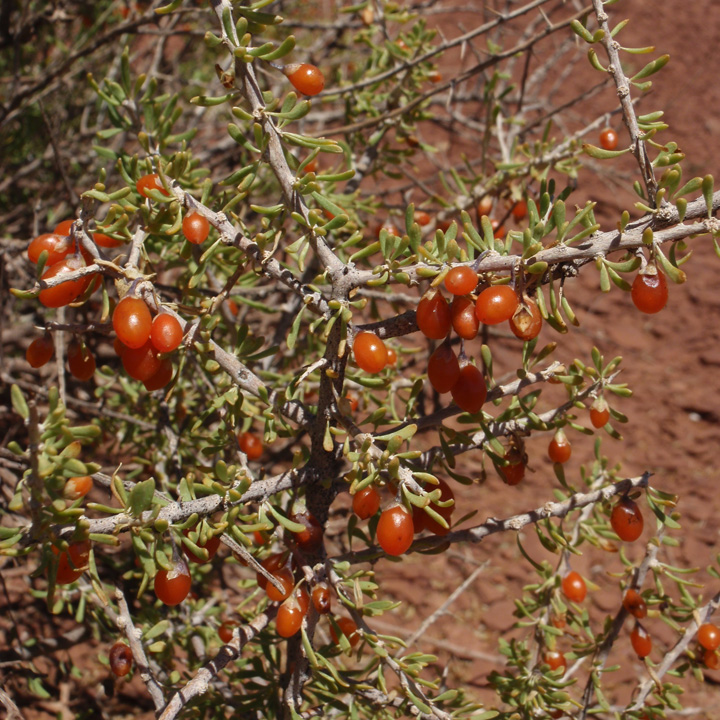
Ripe Wolfberry
Gogi berries have been quite the rage for the past few years as a sort of super food.  I am sure the berries are very healthy but there really isn't any scientific support for them as a super food at this time.  At a minimum though they are just as healthy as any other berry, which other berries are indeed very healthy.  Here in the Sonoran Desert Wolfberry is quite common, especially along dry washes.  Between now and the  middle of May is when they are ripe for harvesting, and they are quite easy to find.  They look like miniature tomatoes that grow on medium to small sized bushes.  The resemblance is for good reason, both Wolfberry and tomato are in the same plant family, specifically the genus Lycium.  They sure don't taste like tomatoes though, but probably closer to a raspberry.  The amazing thing about Wolfberries is that their size varies significantly from year to year depending on timing and amount of rain received during the winter months.  Years with little rainfall will yield tiny berries that are not worth picking.  Years with more rainfall will yield nice sized berries slightly smaller than a raspberry.  This year I have noticed that Wolfberries along washes are niced sized while those outside of washes are too tiny to pick.

Anyway, its the right time of year to search out this berry along desert washes.  Be sure to bring a good plant identification key so you can be sure to correctly identify what to pick and not to pick.  The best way is to identify the plant by leaves, berries, and the flowers.  Unfortunately, the small purple flowers have been gone since February.  In future years though, consider searching out the plant by flower in February, then remembering its location come back to harvest berries in April.  My guess is that these wild gogi berries are healthier than what you can buy in the store, if for no other reason other than the fact that you have to hike around to find them.
Wolfberries small purple flowers, usually found in February.