Showing posts with label Mushrooms/fungi. Show all posts

Monday, July 30, 2012

Huitlacoche: Corn Smut


Big scale farming has made huge efforts to do away with corn fungal infections.  They of course have very good reasons for doing this being parasitic fungi can devastate a crop.  Today, there are a number of corn varieties that are resistant to fungal infections.  Native Americans and even some Mexican farmers today, however viewed corn fungal infections much differently.  For these people, corn fungal infections are are a good thing and even encouraged.  Why?  Well, they view corn mushrooms as a delicacy.  Historically, certain varieties of corn were actually bred so they would be easily infected with the fungus.  Some Native Americans even scratch and infect corn purposely to produce the mushrooms.  I have grown many different varieties of corn over the years and old heirloom Native American varieties almost always are far more susceptible to to fungal infections than any other type of corn.  Both modern and pioneer hybrids and heirloom varieties are far less susceptible to fungal infections.  This is simply because of selective breeding.  Native Americans selectively bred varieties that favored infection while pioneers and modern farmers selectively breed corn so it won't be infected.

This corn fungus, or mushroom, is more commonly called corn smut.  In Mexico it is commonly called Huitlachoche.  Corn smut spores are carried to corn plants through wind blown dust and rainfall.  For this reason, even a fields separated many miles from one another can infect each other.  Corn smut also infects plants best at temperatures above 80 or so degrees.  Being I have grown corn both in the Midwest and the Southwest I have observed corn smut infections to be much more prolific in the Southwest, presumable because it is so much hotter there.  I have also observed that corn smut infections are most prolific during the months of July and August in the Southwest, again presumably because of the higher temperatures.  Typically, the individual grains of corn become infected with the fungus.  Any part of the corn plant can become infected though, as long as a spore finds its way into damaged tissue.  Once damaged tissue is infected, the fungus grows and causes a tan-gray swelling of the area, also known as a mushroom.  This mushroom will eventually produce spores which can infect other parts of the corn or other corn plants.

Today, eating corn smut is not extremely common.  Corn smut typically is reserved for gourmet restaurant menu's where it is called either corn mushroom or huitlacoche.  It can occasionally be found canned in grocery stores.  It is actually quite expensive costing anywhere between 10 to 20 dollars a pound.  I have eaten fresh corn mushrooms a number of times.  When I ate it fresh, as in less than a day old, it was very good.  It had a sort of corn-mushroom-earthy flavor to it.  When I ate it after sitting in the refrigerator for several days it was quite gross and tasted like dirt. If you want to try corn mushroom yourself the easiest way to find it is probably by buying it canned.  If you are patient, you could also try to grow it yourself.  Corn mushrooms are safe to eat if cooked, but never eat a similar looking mushroom if found on a different plant.  For example, smuts that grow on wheat are extremely toxic.

Friday, April 27, 2012

Plant Galls: Where Do They Come From?

Creosote gall.
This morning while hiking I came across a few odd masses of leaves growing on Creosote Bush.  These masses of leaves are technically galls caused by the Creosote Gall Midge.  This insect lays an egg or eggs along with fungal spores in part of a Creosote Bush.  There are 15 species of the Creosote Gall Midge, each specializes in laying their eggs in a specific location on the bush.  Some specialize in laying the egg and forming galls in the leaves, others on stems, others buds or flowers and so on.  Each species also does this only at specific times of the year.  When the fungus begins to grow it forms a gall on the Creosote.  Later, the midge eggs hatch and the larva begin eating the fungus inside of the gall.  Once mature, the larva eat their way out of the gall and morph into adult insects.  Once adults, the whole process is of laying eggs with fungal spores in the Creosote begins again. 

Galls are not unique to Creosote.  In-fact they are quite common, especially among oak species.  Gall wasps actually specialize in forming galls, most often on oak leaves.  Gall formation almost always is part of the reproductive life cycle of these wasps.  There are well over 1000 species of Gall Wasps, each individual species specializing in forming galls on one specific plant species.  These galls are often quite unusual looking, sometimes looking even Christmas ornament like.  Below are a few pictures of galls.


Friday, March 23, 2012

How to Grow Mushrooms in the Desert

Larger but still dehydrated oyster mushrooms.  These mushrooms are rock solid due to the dry desert air.
Growing mushrooms in the desert can be quite a challenge.  Between the heat and the dryness it can seem nearly impossible.  I have been trying to grow oyster mushrooms here in the Sonoran Desert for quite sometime now without much success.  The first and primary problem is simply the lack of humidity. Before you ever get mushrooms to form, you must first colonize some sort of substrate with mushroom mycelium.  Mycelium is sort of like the "roots" of the mushroom. I have found it nearly impossible to colonize compost bins with mycelium simply due to the lack of humidity.  However, a more enclosed compost bin that traps moisture better may help, but also may make the process of composting more difficult.  Growing mycelium in quart or larger sized ziplock bags has worked extremely well though being the bags trap most of the moisture.  Growing mycelium though is the easy part. 
A few elm oyster mushrooms grown in the enclosed chambers described below.
Getting fruiting bodies, that is mushrooms, is extremely difficult through.  Nearly from the day tiny baby mushrooms form they begin to dry out and there growth is stunted.  I have grown many tiny mushrooms that dehydrate in the dry desert air before they are more than an inch tall.  I have found that soaking mycelium in water for 24 hours prior growing mushrooms helps, but the mushrooms still dehydrate after a short period of time.  They do get a lot bigger than the non-soaked mycelium mushrooms but still not more than two inches.  Putting the mushrooms in an enclosed container where the humidity is elevated also helps but creates its own set of problems.  In enclosed containers the mushroom mycelium can quickly consume most of the oxygen.  Mushrooms don't form well with low oxygen levels and form weird mutant looking stalks.  To over come the low oxygen levels I drilled holes in the side of the enclosed container and this has allowed for the most success.  Holes in the side of the container lower the humidity levels though, again causing dehydration problems.  So I have had to work to balance humidity levels and oxygen. 
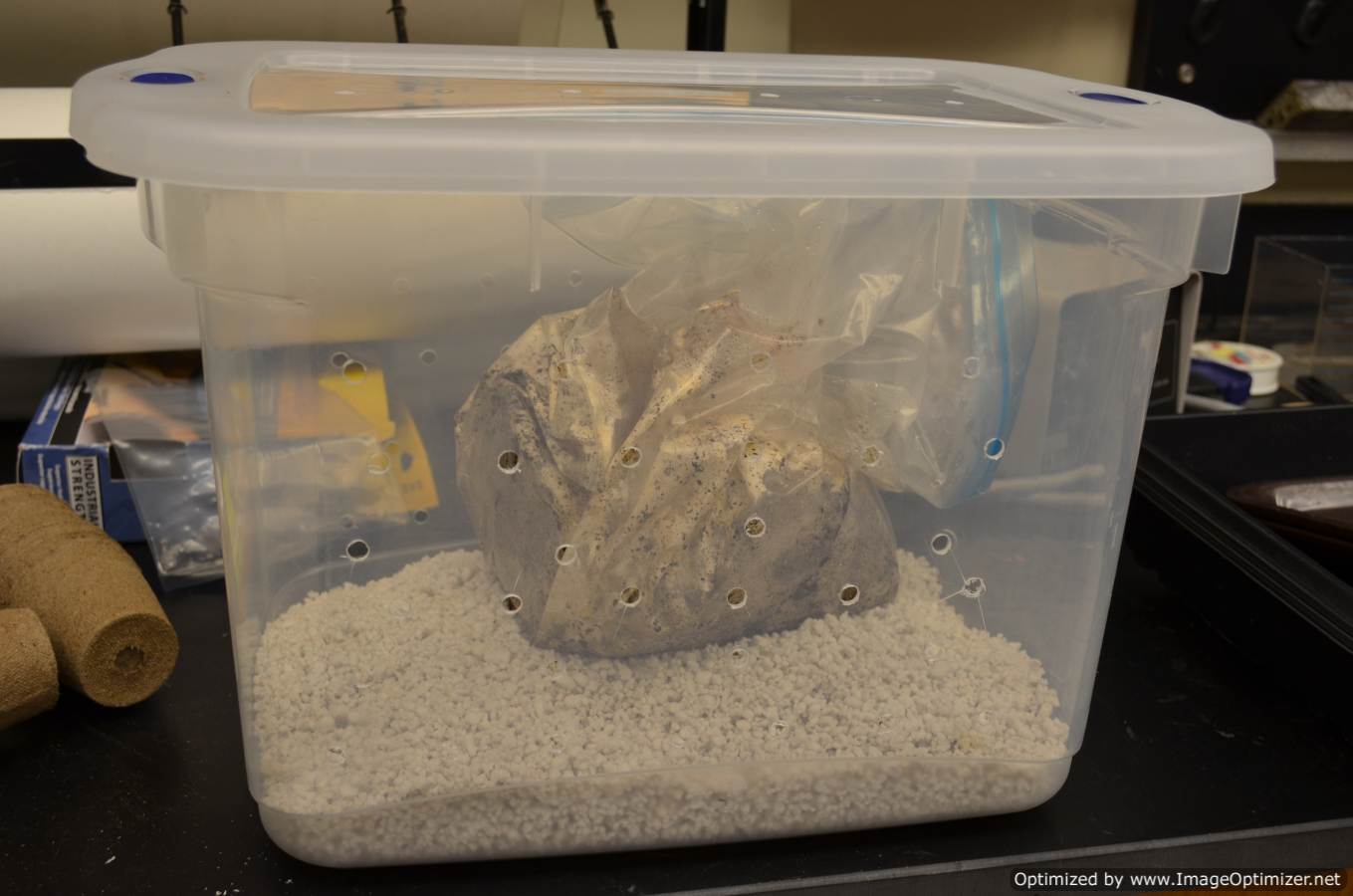
The enclosed chamber we use to elevate humidity levels for growing mushrooms.
My current set-up is a large clear plastic bin with holes about every two inches on two sides and the top.  The bottom of the container is filled with perilite that is soaked with water, this helps raise and maintain humidity levels.  The mycelium is in a plastic bag that sits on top of the perilite.  There is a three or so inch slit cut in the side of the mycelium bag for mushrooms to grow out.  About once a day I open the container and spray it down good with some water.  So far it appears to be working. 

Friday, September 9, 2011

Mushroom Hunting


The Perennial Plate Episode 69: Mountain Morels from Daniel Klein on Vimeo.

While I'm not much of a mushroom hunter, I sure would like to be.  Being the desert is about the worst possible place for mushroom hunting I'm sort of out of luck.  Arizona's higher elevations do offer some decent mushroom hunting.  Outside of the desert though, mushroom hunting is an excellent way to get outside and learn about all kinds of things in the outdoors.  Anyone can do it just make sure you have the right field guides for identifying mushrooms and go along with someone that is experienced.  You can learn all sorts of ecological secrets in the process of mushroom foraging.  Of course, never eat something that you aren't absolutely sure of what it is.  For most of North America Morel season is months behind us but for more northern and mountainous regions they can be found in abundance as seen in this video.  This is episode 69 of the Perennial Plate and is filled with interesting ecological facts about Morels as well as great mountain views.  The Perennial Plate also has a great website with weekly videos and blog entries.

Tuesday, May 24, 2011

A few Iowa fungi and mushrooms

On my recent May hiking trips through Iowan woodlands I cam across a few interesting fungi.  Being Iowa has had a very cool and wet spring there is an abundance of certain types of mushrooms and an absence of others. 

An unknown bracket or polypore fungus growing on dead wood.  I believe this is Polyporus squamosus, or Dryads Saddle, but never positively identified it. 

I came across an abundance of a bracket or polypore fungus growing on dead wood throughout the woodlands.  Bracket fungi are shelf shaped and almost always grow on dead wood.  They are also called polypores because of the small holes or pores they contain on their underside.  Most familiar fungi that you might see in the grocery store have gills, or lines of fleshy material on their undersides, instead of the pores found on these mushrooms.  This fungi also had brownish scales on their top side and a very short stem.  I believe (I don't know for sure!) the particular type I found in the greatest abundance is known as Dryads Saddle or Polyporus squamosus.  This particular mushroom is generally not considered edible being it toughens up considerably as it ages.  It is not poisonous and some people do eat before it toughens up.  I didn't positively identify this fungus so I was not about to eat it, and neither should anyone else if they do not positively identify it! 

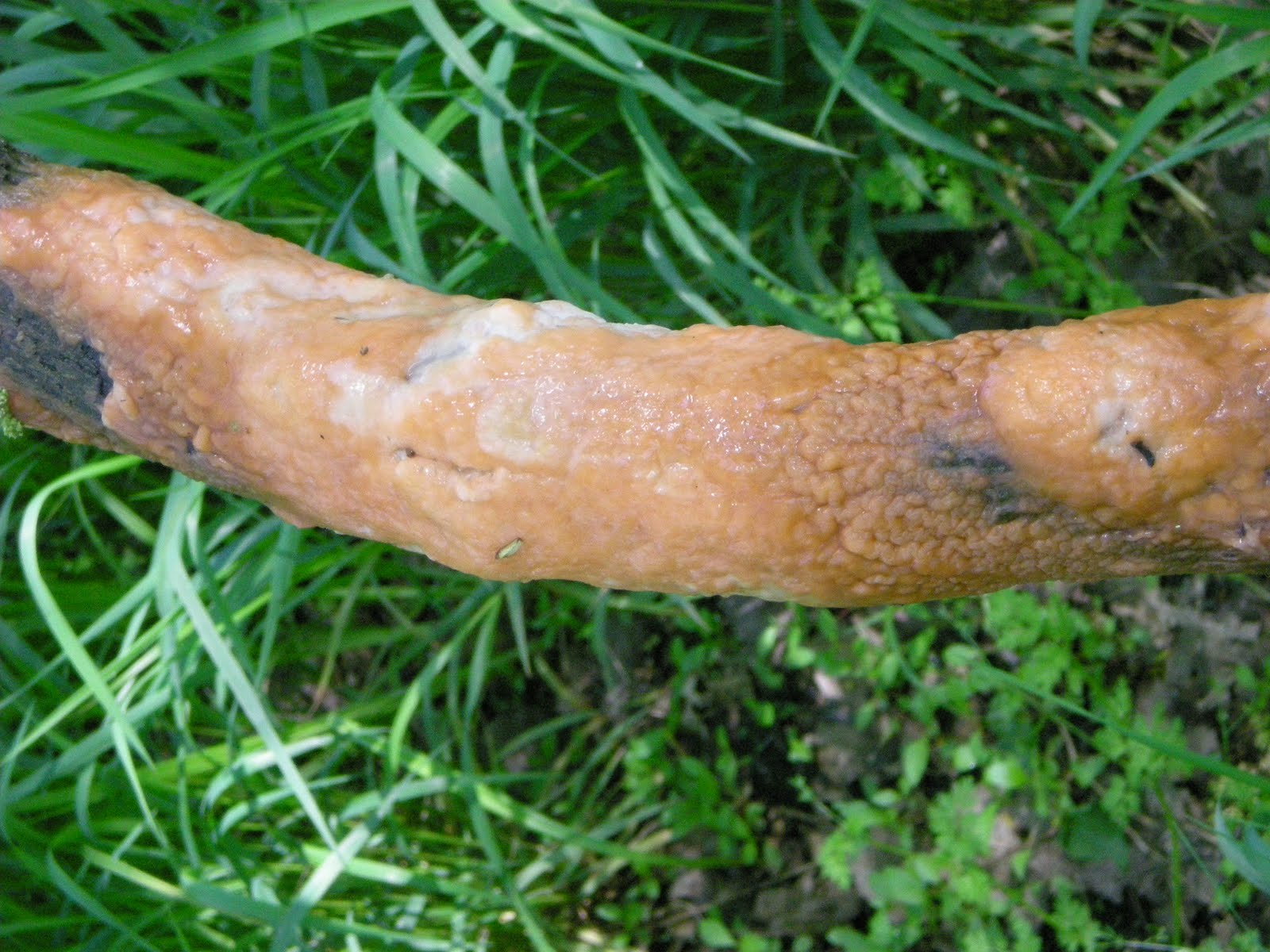
I also came across a slimy orange/white fungus growing on a dead grape vine.  I have no idea what it was.  Was the orange/white stuff on the surface of the vine mycelium the root like structure of mushrooms?  Or was this the immature fruiting body?  I would have had to come back at a later date to figure it out.  But even so, it was pretty interesting. 

An unknown orange/white fungus growing on a dead vine.

In very short supply were the Morel Mushrooms this spring.  Unusually cool weather apparently has prevented them from popping up in the woodlands this spring.  Hopefully slightly warmer weather will cause some to come up soon.  I however, am not a skilled Morel hunter...  so it may just be me...

Monday, January 10, 2011

Useful and free spent coffee grounds

Spent coffee grounds

Spent coffee grounds are one of the most useful, abundant, and widely available waste streams in America today.  For those who do not know, spent grounds are simply used coffee grounds.  Unfortunately, home coffee makers, offices, cafeterias, and coffee shops dispose of almost all of them every day.  There are several great biological uses for spent coffee grounds.

Biologically speaking, grounds are excellent life supporting material.  They are over 90% carbon, 5% nitrogen, and 0.5% potassium, and 0.5%  phosphorous.  All of which is biologically available.  PH is around 5.5.  If spent coffee grounds are left in the open air for several days, numerous molds of different colors begin to colonize the surface.  I have seen blue, green, white, gray, and yellow molds growing on spent grounds.

Here are some of the ways I have used spent grounds:

Garden soil amendment: Simply mix a small amount of grounds in with the soil.  From my experience there is no reason to mix in more then about 10% grounds into the soil.  Higher percentages of grounds can actually be harmful to the soil and plants by lowing the pH too low or by introducing too much nitrogen.

Compost: Adding coffee grounds to a compost pile lowers the pH and raises nitrogen.  Both speed up the composting process and increases the quality of the final compost.  However, I wouldn't make a compost pile more than about 20% coffee grounds.  Too much nitrogen from the grounds can again harm plants and make the compost process difficult.

Mulch: Spreading coffee grounds on the surface of a garden, or around other plants works well as a fertilizer and is a slight bug deterrent. 

Compost tea: Add into compost tea to lower pH and raise nitrogen.  Some people have found that by making a tea with only spent grounds, the tea can be dumped on plants to prevent and to "cure" insect infestations.

Growing mushrooms: Spent coffee grounds grow oyster mushrooms very quickly and successfully.  In-fact some people have started businesses doing this.  Check out Back to the Roots for a very cool example of a spent coffee grounds mushroom farm.


Fungi spawn substrate:  Not all fungi will form mushrooms on coffee grounds though.  But, even if mushrooms will not form for a particular fungal species, the mycelium will still grow so grounds can be used as a spawn substrate.  

Worm food: Add spent grounds into a worm bin to make worm castings.   I have never done this but would guess to add no more then about 30%.  From what I hear worms absolutely love coffee grounds.

A few years ago you could stop at any Star Bucks and they would have coffee grounds set aside for people to take for free.  Well apparently not enough people picked up these grounds so now you have to ask them to set them aside for you.  I have asked many different coffee shops and cafeterias to set aside grounds for me and they are all very willing to do it.  You may have to explain yourself to them as this may seem very weird and confusing to them. So, find a coffee shop and ask if they will set grounds aside for you.  I am sure, that soon enough you will have more grounds then you know what to do with, and all for free.

Thursday, January 6, 2011

Fungi amazi

Last summer I came across Paul Stamets TED lecture "6 ways mushrooms can save the world."  To say the least, I found the lecture fascinating and immediately started working on several projects centered around fungi.  These projects have and continue to involve the following: growing oyster mushrooms, mycorrhizal plant associations, composting with Hypsizygus ulimarius, mushroom/garden companion planting, and various other mushroom growing techniques.  I will be posting some of these experiments in the future.

Stamets company is Fungi Perfecti and can be found at this website: www.fungi.com/index.htmlFungi Perfecti is an extremely interesting company centering around growing and using fungi for very practical applications.  A lot of what they do is very cutting edge.

I have also read two of Stamets books: "Mycelium Running" and "Growing Gormet and Medicinal Mushrooms".  Both of these are great books for learning about fungi and their practical applications in nature, agriculture, health, and economics.  They really opened my eyes up to a lot of basic but very meaningful experiments the average non-scientist could do.  There seems to be a lot of potential for non-scientists to contribute significant information to the scientific world.

Here is the video of Paul Stamets TED lecture "6 ways mushrooms can save the world". This lecture is largely based off of his book "Mycelium Running".

Growing mushrooms conclusion

Two months ago I began growing oyster mushrooms on coffee grounds.  Here is that initial post.  I simply mixed some oyster mushroom spawn with spent coffee grounds I got from the school cafeteria.  Well, things went pretty well but not perfectly.  The mushroom mycelium grew quite well on the coffee grounds and I was able to grow quite a few mushrooms.  I had one major problem though.  Being that I was growing them in the desert the mushrooms almost always dehydrated before they were a few inches tall.  So I ended up with tons of tiny shriveled-up mushrooms.  I tried several methods to increase the humidity, none of which worked adequately.  When I enclosed the entire bucket in plastic to preserve moisture the fungi didn't have enough oxygen so deformed mushrooms formed.

An abundance of small, dehydrated oyster mushrooms growing on coffee grounds.  The white surface is mushroom mycelium.  Mycelium are sort of like mushroom roots.

Same bucket two months ago.  The black coffee grounds quickly turned white as mycelium grew.
I do have this to say though.  The few mushrooms that I did get from the bucket were by far the best I have ever tasted.  I plan on trying to grow mushrooms in the near future again.  This time however I will have to create some sort of terrarium that holds in the moisture but also allows for air exchange.

Monday, November 1, 2010

Growin' 'shrooms

Growing mushrooms is something I have been interested in doing for a long time.  It is also kind of something I have been scared of, fearing I might grow some sort of poisonous mushroom by accident.  Finally, after reading up on mushroom growing I overcame my probably unfounded fear and purchased Espresso Oyster mushroom spawn from Fungi Perfecti for $26.  Mushroom spawn is simply a mass of mushroom mycelium growing in some type of medium.  Mycelium is a mass of fungal hyphae which are similar to plant roots but for fungi.  Mold is the most common way of referring to mycelium or hyphae.

A mass of oyster mushroom spawn growing on sawdust.
Fungi, though often associated with plants are in-fact not plants at all.  I suppose they are somewhere between a plant and an animal.  Plants use sunlight to photosynthesize water and carbon dioxide into sugar for energy to live.  Animals must consume food for energy, which is similar to mushrooms.  As we know however, animals eat food and digest it internally in our stomachs.  Fungi are weird in that they actually digest their food outside of their body first and then consume it.  This is exactly what mushroom (fungi) mycelium is doing in dirt, on your bread, in wood, or as in the spawn above. 

Supposedly, growing mushrooms is pretty easy.  They don't need a lot of light, they just need some sort of growth medium or "food", and some water in a semi-sterile environment.  So I chose two growth mediums or "foods" for my spawn, used coffee grounds and toilet paper.  According to what I read both are excellent growth mediums for oyster mushrooms.  Both mediums need to be sterilized and fortunately used coffee grounds are sterilized in the process of making coffee.  Toilet paper on the other had needs to be sterilzed with boiling water.  I simply boiled tap water and poured it on top of the role of toilet paper to sterilize it, amazingly it absorbed about half a gallon of water.  Once the paper cooled I removed the cardboard cylinder from the middle and filled the hole with spawn.  Then the toilet paper role and spawn were closed up in a gallon sized plastic bag with the bag left slightly open to allow for breathing.

My sterilized toilet paper roll with spawn filling the middle hole.  The brown specks are pieces of saw dust.  The core of sawdust spawn appears white in this picture because it has been covered with white mycelium.  Normally this gallon size plastic bag would be nearly closed to prevent contamination and to hold in moisture. 

As for the used coffee grounds, eight holes were drilled into the bottom of a five gallon bucket and about three gallons of coffee grounds were mixed with about 3/4ths gallon of spawn.  The spawn and coffee grounds were already pretty wet so no water was added.  Eight holes were also drilled around the surface of the mixture to help drain off carbon dioxide.  Lastly, a plastic bag with holes in it was used to cover the bucket to help hold in moisture and prevent contamination.

Mixture of about three gallons of used coffee grounds and 3/4ths gallon of sawdust spawn.  Holes in bucket around surface of mixture were drilled right after this picture was taken.  Bucket was then covered with a plastic bag with holes to hold in moisture and prevent contamination.
From what I read mushrooms should be growing in about three weeks from both of these mediums.  Hopefully that is the case but you never know.  I have botched up my fare share of experiments in my life.  Botching is a normal part of the scientific discovery.  If it is botched up hopefully I'll discover something awesome.  I'll report back on the results in several weeks.