|
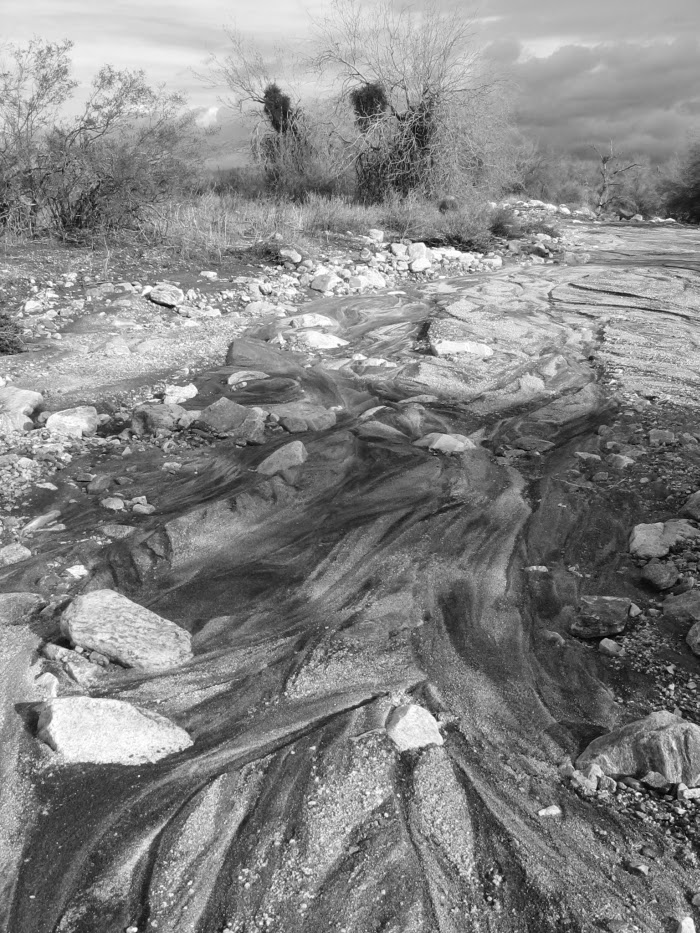
| Sonoran Desert after a rainfall. Within days the leafless plants in this photo will sprout leafs. |
Well, we had a decent rain finally this past weekend in the Sonoran Desert. So in honor of that, this post is the first of a two part series on desert hydrology. Part 2 will be posted this coming Friday.
All desert life clings to water. As odd as it might sound all desert life is intensely shaped by water. When passing clouds condense and rain across the landscape a desert raindrop scarcely finds any impediments between it and the ground. That is, of course if the raindrop doesn't evaporate before hitting the ground, a common desert frustration. Sparse vegetation allows most rain direct access to the ground, its most logical destination. However, being most precipitation events are quite small, once a raindrop falls soil moisture is typically short lived, and rapidly evaporates back into the atmosphere, renewing the scarcity of moisture. This scarcity is exactly what created the desert in the first place and creates the often dusty atmosphere or the semi-frequent dust storm. Combining together, rain and dust can turn into another uniquely desert phenomena, muddy rain. All rain, muddy or not, is coveted by desert life. And all desert rain brings with it cleansing and life. The once dusty atmosphere is washed crystal clear after rain subsides and plant and animal life is renewed.
Trace Rain
Even trace amounts of rain have an effect on the desert. If a few raindrops are fortunate enough to fall on black soil crust moisture is readily received by the ground. Cryptobiotic soil crusts thinly coat desert soils in undisturbed areas. Most of the year these crusts lay shriveled and dry on the soil surface, with no obvious signs of life. But even minute trace amounts of rain spring to life microscopic cyanobacteria and fungi composing these crusts. Once awaken, brittle crusts transform into slightly swollen, softer, and biologically active versions of what they were before. Cyanobacteria rapidly absorbs sunlight in order to photosynthesize and harvest nitrogen from the air. Nitrogen is then deposited into the soil, serving nutrients to associated fungi as well as nearby plants. These crusts cling to water, holding it in the top centimeter of soil much longer then if these crusts were absent. But hours to days after rainfall, once the soil crusts dry out, they return to their original dry brittle form.
 |
| These spine lined ribs of the Saguaro expand apart as the cactus stores water in the stem and shrink together as water is used up. |
More Rain
If a fortunate larger rainfall event occurs, say one-half inch, raindrops will penetrate much deeper into the soil bringing to life dormant plants. As this moisture soaks is it pools above impenetrable caliche soil horizons. Rarely does rain ever penetrate below the caliche line which is typically around two feet below the surface. Shallow rooted plants such as cacti and Triangle-Leaf Bursage are the first to take advantage of this new moisture pooling above the caliche. Desiccated plant roots rapidly respond by growing new rootlets, exploiting as much of the shallowly penetrating moisture as possible. New rootlets transport water to the stems of plants which in the case of cacti begin to swell. After long months of drought, the accordion shaped exterior of a Saguaro cacti appears compressed due to water loss. Water loss during rainless periods decreases the diameter significantly, leaving a thin anemic looking cactus. However, as water is rapidly absorbed the accordion shaped exterior expands as the cactus swells and becomes plump. The cacti chug as much water as fast as they can, storing it in their stem tissue for later use. This drinking strategy categorizes cacti with other succulents as water storers. Storage of water within expandable stems serves to supply cacti with water for continuous slow growth and metabolic function months after soil moisture has been depleted and other plants appear shriveled and dry. Once soil moisture is depleted smaller cacti roots die and are shed while large roots remain intact but enter a state of dormancy.
 |
| Ocotillo sprouting new leafs and flowering after spring rains. |
Other shallow rooted plants such as Triangle-Leaf Bursage or Brittlebrush also absorb water but at a slower pace. These plants, known as intensive exploiters, utilize very shallow roots to exploit only shallow soil moisture. Rather than storing water, these plants instead quickly resurrect seemingly dead crunchy leaves, turning them green again. Available water is also incorporated into new stems and leafs, growing the plant as fast as possible. When moisture is depleted new roots are shed, growth stops, and leaves slowly shrivel and are shed. Plants can become so shriveled and leafless after long rainless periods that they can appear all-together dead. Some plants such as the Ocotillo only sprout leafs after rainfall, then shedding them as the soil drys. Other plants prefer deeper moisture and for this reason avoid soils with caliche. Caliche often prevents rainwater from penetrating deep into the soil, therefore preventing deep rooted plants from establishing themselves. Younger soils without caliche therefore become the primary home for the deep rooted Creosote Bush and Mesquites.

Friday I will post the rest of this article about water in the desert. See you then!