Showing posts with label Desert plants. Show all posts

Friday, February 1, 2013

Legumes: Self Fertilizing Plants

The green stem of the legume palo verde tree in the Sonoran Desert.
Determining how to fertilize a plant can be quite the difficulty.  You may have heard that most people over water their plants, but it is also true that most people over fertilize their plants.  Certain plants however never need to be fertilized simply because they have "figured" out a way to fertilize themselves.  Bean plants, also called legumes, form a symbiotic relationship with a bacterium known as rhizobium.  The air we breath is about 70 percent nitrogen, an essential nutrient for plant fertilization.  Atmospheric nitrogen however cannot be used by plants, it must be converted into a different form called ammonium.  Rhizobium bacteria has the ability to take nitrogen gas and convert it into ammonium.  This changing of nitrogen gas into ammonium is known as nitrogen fixation. 

Using legumes in the garden can be quite a useful way to fertilize your plants naturally.  Farmers in the Midwest will often alternate between corn and soybeans, taking advantage of the fact that soybeans naturally replenish the soil with nitrogen fertilizer that the corn can use.  In deserts, which have soils that are naturally deficient in nitrogen, plants must either be adapted to living in soils with low nutrients or have the ability to fix their own nitrogen.  For this reason, legumes are extremely common in desert ecosystems.  Legumes are not just your typical bean plant, they also grow into bushes and trees.  In the Sonoran Desert palo verdes, mesquites, ironwoods, and acacias are all small legume trees that form bean-like pods.  Typically, these legume trees will form islands of soil under their canopy that are rich in nutrients compared to soils beyond the canopy.  Because of the slightly richer soil many smaller plants will often be growing in this micro-environment. 
The darker growths on these plant roots are tumors infected with rhizobium bacteria.
Legumes and Rhizobium bacteria form their association with each other in the soil-root environment.  Rhizobium are naturally occurring soil bacteria but don't really do much if they haven't infected a legume.  When bean seeds germinate and begin to grow, rhizobium already present in the soil infects the new plants roots.  Points of rhizobium infection in the roots form into tumorous-like growths which are like little nitrogen fixing factories.  Typically we think of tumors as unhealthy but be assured, this type of plant tumor is very healthy and beneficial to not only the infected plant but also to the entire environment.  Legume plants that for some reason are not infected become extremely anemic with stunted growth and yellow coloration. 

Tuesday, January 8, 2013

White Tank Mountains Goat Camp Trail

Desert grassland with mainly tobosa grass located at the top of the White Tank Mountains west of Phoenix, Arizona.
Goat Camp Trail in the White Tank Mountains west of Phoenix is the longest trail in the park.  It can be done as a 13 mile loop along with the Mesquite Canyon and Bajada trails or a 12 mile hike from trail head to end and back.  The trail head is just past the park entrance on Black Canyon Road.  The first mile and a half of this trail is pretty easy starting at 1600 feet in elevation and hiking up a bajada.  This bajada is fairly interesting.  It has been highly disturbed by some major flood events along the dry washes that come out of the mountain canyons.  This disturbance is evident increasingly as you hike towards the mountains by the presence of large boulders laying on the surface.  Normally, these boulders would be sitting lower in the sediments of the bajada being at least partially buried in the dirt.  Large floods however coming from the canyons washed away a lot of these sediments but were not strong enough to wash away the larger and heavier rocks.  So the rocks remained in place while the finer textured sediments washed downslope.  These unburied boulders become increasingly common upslope where the flood, or floods, were more powerful.  These floods resulted in increasingly variable disturbed soil conditions higher up on the bajada and closer to the mountain.  As a result of the more variable soil conditions plant diversity also increases up slope.  Sections of undisturbed soils typically have triangle leaf bursage while the disturbed sections brittle brush.  Other species such as palo verde and jojoba also seem to like the flood disturbed soils.

After a mile and a half or so, the trail begins to head up the mountain.  This trail has an elevation gain of about 1700 feet, topping out around 3300 feet.  With the elevational gain, average annual temperature decreases several degrees and rainfall increases several inches.  At the mountain base, rainfall averages about 8 inches annually.  At the higher elevations rainfall probably averages around 14 inches annually.  There is a rain gage at the top of the White Tanks but apparently gusty winds around the peak prevent it from collecting rain properly, so it is difficult to get an exact measurement of rainfall at the peak.  Regardless, the vegetation tells us that rainfall is significantly higher and temperatures slightly lower.  In the past decade or so I have seen snowfall above 3000 feet in the White Tanks only one time and never below that level.  The lower temperatures, specifically lower freezing temperatures in winter, make conditions less ideal for cacti such as the saguaro.  Saguaros are not able to survive freezing tempertures for longer than 24 hours.  While the saguaro does grow near the peak it is quite rare in comparison to lower elevations.  This is at least partially due to the increase in the amount of time freezing temperatures occur at the higher elevations.

I think there may be another, possibly better, explanation for the decrease in cacti towards the top of the White Tanks though.  Around 3000 feet the vegetation strongly shifts towards a desert grassland dense with tobosa grass.  Tobosa increases because of the increased rainfall and because it can survive the freezing temperatures quite easily.  Dense tobosa grass is possible out competing the cacti at these higher elevations.  Another indicator of a problem for cacti at these higher elevations is the presence of charcoal.  Obviously charcoal indicates fire has been present in the area at sometime in the past and cacti in general do not survive fire very well.  Grass, such as tobosa, however, are very flammable and actually encourage fire to some extent.  Grass, unlike cacti, are very adapted to fire through.  While I have never seen or heard of a grass fire at the top of the White Tanks, the charcoal is evidence that it has happened at some time in the past.  Even if fire happens only once every few decades, that is enough to severely limit the population of cacti in the area.

A few other plants that are relatively common at the higher elevations include desert agave and crucifixion thorn.  Most of the desert agaves are pretty small and almost all appear to be clones that have grown from root sprouts of older plants.
Crucifixion thorn.

Desert Agave


Friday, December 14, 2012

Fall Leaves in a Sonoran Desert Riparian Zone

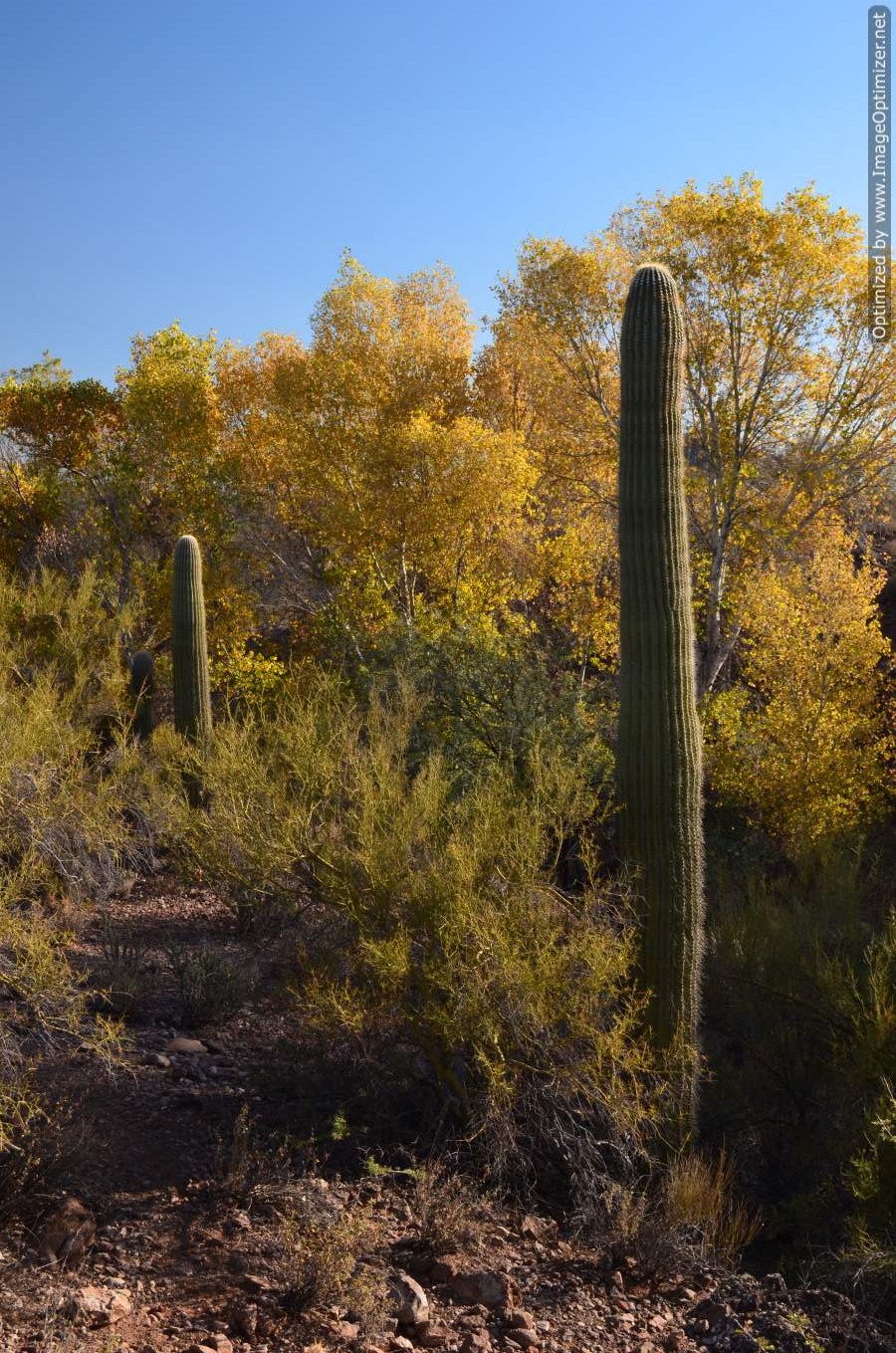
A Sonoran Desert riparian area in fall along Cottonwood Creek.
The desert is most definitely not known for spectacular fall colors.  Fall colors do however, find their place along some of the wetter desert water courses.  If perennial water sources are available, even if it is hidden below ground a short distance, the roots of large deciduous trees will find there way to it.  Sycamores, cottonwoods, and willows are all relatively common along streams and washes with perennial sources of water.  Even Arizona walnut and ash trees can be found in some of the more stable riparian zones.  These trees do not display the brilliant hues of red and orange common to eastern forests but do show off bright yellows that are in stark contrast to the dried out browns and greens of the desert.    Desert fall leaves are quite a rarity and are quite unique.  Typically, perennial water sources are considered perched water tables.  A perched water table simply is water that accumulated above the surrounding water sources, most often a result of bedrock that prevents water from penetrating deeper into the soil and out of reach of plant roots.

A recent hike I took demonstrated this concept extremely well.  The hike was along Cottonwood Creek near Lake Pleasant north west of Phoenix.  The majority of this hike is along Cottonwood Creek, which really isn't much of a creek considering water only flows in this creek a few hours every year.  The rest of the year the wash remains mostly dry, except for a few locations.  Nearly all washes in the desert are called dry washes, and for good reason: they are completely bone dry the majority of the year.  A few washes, such as Cottonwood Creek are fortunate enough to have areas that always remain wet.  Cottonwood Creek owes this moisture to its underlying geology.  First off, the creek bed lays at the base of two small bajadas between two small mountain ranges.  One bajada lays to the north of the creek bed and one to the south.  These bajadas and bedrock of the mountains are relatively steep and provide ample runoff to Cottonwood creek so it will run during periods of heavy rainfall.  Moisture is quickly lost into the deep sediments of the bajada and placed out of reach of deciduous tree roots.  In areas where bedrock are shallow though, moisture cannot penetrate deeply and remains closer to the surface within reach of plant roots.  Bedrock can also push water flowing underground towards the surface.  At these locations large deciduous trees take advantage of the shallow moisture and can in a few places form small but beautiful wooded areas.

Wildlife may not be obvious in these small wooded areas, but if you look at the ground you are sure to see evidence of animals.  Javelina and mule deer heavily utilize these small areas and their hoof prints are normally abundant.  In some area, such as along Cottonwood Creek, wild donkey's are also abundant and heavily utilize these areas.  The abundance of shade, food, water, and cooler conditions during hot dry summers gives great value to these areas for every creature.

Tuesday, November 20, 2012

Echinocereus sp.: The Hedgehog Cactus

Echinocereus engelmannii
The hedgehog cacti are probably my favorite group within the cactus family.  I find their forms, including shapes and spines very interesting.  Their flowers come in an assortment of beautiful colors ranging from pink to red to white to yellow to purple.  Flowers also survive quite a few more days than other cacti flowers.  The scientific name for hedgehogs is Echinocereus.  Fittingly, echino means "hedgehog", and cereus means candle.  I suppose the individual stems may look somewhat like a hedgehog or candle, but I consider them to look more like a cucumber standing upright.  The stems of hedgehog cacti most often are clumped together but with several species they are individual or forming mounds.  Hedgehog cacti are common throughout SW United States and NW Mexico surviving in the low deserts to the high mountains.  The full extent of hedgehogs ranges from South Dakota to Central Mexico.  Identifying these cacti can be a little tricky at times and knowing flower color as well as spine density, length, and coloration is essential.  Even within species there can be considerable variation of traits.  For this reason, botanists have been confused and arguing over classification of different hedgehog cacti for decades.  As time goes on, these botanists seem to discover more and more species, or identify new species out of already existing groups.  Hedgehog fruits are also typically very tasty and Native Americans would eat the fruit as they came across them.  The cacti do not seem to produce a lot of fruit though, so I suppose they were eaten more like a snack.   
Echinocereus coccineus

Echinocereus engelmannii


Friday, November 16, 2012

Joshua Trees, Ice Age Sloths, Extinction, and Climate Change Today


With the end of the Ice Age, the giant Shasta ground sloth became extinct in our American Southwest deserts. This extinction happened as a result of the warming of the continent and invasion of humans into the land 13,000 years ago.  Today, the sloth is long gone, but the consequences of its extinction are still being seen to this day.  The Shasta ground sloth was intimately intertwined with every organism they ate, use, or associate with.  Of course, all organisms that inhabit this earth are intertwined in the same way with all the organisms they eat, use, and associate with both directly and indirectly.  This can be extended to show that all organisms are in one way or another connected.  If one organism is removed from an ecosystem, such as the ground sloth, every other part is affected and must adjust their life accordingly.

Unfortunately, not every organism is able to adjust to every change in an environment.  Such was the case of the Shasta ground sloth.  As the climate warmed, plants that inhabited the Southwestern deserts changed, changing the sloths food sources.  As food sources changed, the sloth could not adjust and as a result became extinct.  As a result, the plants and animals affected both directly and indirectly by the sloth had to adjust to "life after the sloth".  For example, the Joshua Tree was a major part of the sloths diet.  At first it may seem that extinction of something that is eating you might be a good thing.  At first, I could guess, the Joshua tree might have benefited greatly by the absence of a giant animal consuming it.  Long term however, the Joshua tree suffered greatly and continues to suffer to this day.  As the sloth ate the Joshua tree, of course this injured the plant.  However, as the sloth ate, it also consumed the Joshua tree seed which would pass all the way through the sloths digestive tract without being damaged.  Once passing though the sloths digestive tract the seed would find itself in a moist pile of fertilizer, which is an extremely ideal location to find yourself if you are a desert seed in desperate need of moisture and nutrients.  

With this association of the sloth and Joshua tree, the sloth benefited with food by eating the tree.  The
Joshua tree made a trade-off though, being damaged by the sloth as it was eaten, but benefiting from the sloth into the next generation.  The sloth aided the success of the Joshua Tree by likely aiding germination and by carrying the seeds to new locations up to ten miles away.  After the extinction, and up to the present day, only desert squirrels and packrats move Joshua tree seeds today, and only at a pace of about six feed per year.  As a result, the Joshua tree cannot adjust its range anywhere near as quickly as it could before and its range has been shrinking for over 10,000 years now.  How do we know all this?  Scientists in the Southwest have examined caves where sloth dung which tells us what the sloth ate.  Ancient packrat middens also have been examined which tell us where the Joshua tree was and when over the last 10,000 plus years.

With the ability to only change their range six feet per year, the Joshua trees range will continue to shrink in coming decades.  Currently, the climate is warming far to fast for the Joshua tree to keep pace.  This does not mean however the Joshua tree will go extinct.  It will be able to survive in cooler high elevation locations.  As the range of the Joshua tree is reduced however, organisms dependent on it will have to adjust.  For example, many species of rodents are dependent on moisture from the tree during times of drought.  These organisms access water from the tree simply by chewing through the bark to access water.  With the trees gone however, there will be far less water available to support rodents.  And so we see the continued consequence of the extinction of the sloth.

Monday, November 5, 2012

Barrel Cactus Part 2

California barrel cactus, Ferocactus cylindraceus.
Barrel cacti are kind of as their names imply, barrels full of water.  The problem is, the water isn't just hanging out in the cactus like a big glass of water.  The water is stored inside of the cells that fill the interior of the cactus.  The best way to get this water is to eat the tissue, though it won't taste very good and probably will make you sick.  The thick layer of hooked spines will also deter any person or animal from easily accessing this water though.  In drought however, the barrel cacti is one of the best sources of water for desert animals there is, that is, if they can get through the spines.  Small animals like rats, chipmunks, or mice can avoid spines by burrowing underground slightly to where there are no spines and then eating up into the cactus.  I have actually found a few barrel cacti that have been entirely hollowed out by rodents, yet have there skin and spines fully intact.  Larger animals such as deer have no such luck though accessing moisture from a standing barrel cactus though.  The spines become just too big of a deterrent.

Red spines of the barrel cactus show up after being wet by rain.
Fortunately, for larger mammals the barrel cactus has a fatal flaw.  As a barrel cactus grows it generally leans towards the southwest, which is the direction from which the most intense sun comes from.  Nearly all barrels lean to the southwest, just as a compass always points north, thus the common name compass barrel.   It might seem that leaning in the direction of the brightest sunlight might mean the cactus is trying to gather as much sunlight as possible.  This is however the exact opposite of what it is doing.  With the top of the cactus pointing directly at the most intense sun, spines at the top actually shade out much of this light and all sides of the cactus actually avoid this direct sunlight.  The sides however gather the most sunlight from the sides, as the sun comes up or goes down, when the sun rays are less intense and therefore less damaging to the cactus.  Pointing tops towards the most intense sunlight is therefore actually a protection mechanism, rather than a gathering mechanism, against intense sunlight.
A barrel cactus that fell over due to leaning towards the southwest.  Even though this cactus fell over, it continues to grow.
Leaning is an important adaptive strategy of the cactus, but is this strength also lays a huge weakness.  As the barrel cacti grows and leans it becomes very off balance.  Older, large cacti will often simply fall over.  Oddly, even when the cactus falls over it will continue to live and grow as it lives laying on the ground.  Once the barrel cactus falls over, the underside of the cactus is exposed which is unprotected by spines.  Large mammals will often start eating the barrel from this unprotected portion during drought.  
Flower of the California barrel cactus Ferocactus cylindraceus.

Friday, November 2, 2012

Barrel Cactus Part 1

Compass Barrel cactus
The barrel cactus is one of the most common cacti in the Southwest.  There are four different species common to this area of the country, the most common of which are the compass barrel and the California barrel.  It can be extremely difficult to distinguish between these two common species of barrels.  In southern Arizona, such as around Tucson, the compass barrel is the most common of the two cacti.  In central Arizona such as around Phoenix, southern California, and even into the depths of the Grand Canyon the California barrel cactus is the most common.  Their ranges overlap in central Arizona and their similarities are pretty extensive.  Without closer investigation you may not be able to determine what specific species a particular barrel is, there are however a few differences that may help in identification.  First off is shape.  Of course, barrel cacti are all sort of barrel shaped.  The compass barrel is a little more wide and plump than the California barrel.  The California barrel  is a little skinnier.  The second way to distinguish between the two is by looking at the spines.  Both have very interesting spines which are often red colored.  This red coloration gives a sharp contrast to the dark green of the cacti's body, especially after a rare rainfall.  Both cacti also have flattened central spines that have a ribbing pattern on them.  The central spines are also hooked, giving both cacti another common name of fishhook barrels.  Compass barrel cacti spines are however considerably more hooked than California barrels.  Compass barrel central spines are a full "fishhook" shape and were in-fact used as fishhooks by some Native Americans.  California barrel central spines are closer to a 90 degree curve than an actual fishhook.  These are the best ways, though not necessarily foolproof ways of distinguishing the two while out in the desert.

In our next post we will talk about the leaning habit of barrel cacti.
California barrel cactus front left of picture.


Monday, October 29, 2012

How To Identify a Cactus

The columnar saguaro cactus.  Note the huge column like shape and ribs lined with spines traversing from the bottom to top.
Cacti are one of the most diverse and interesting plant families in the plant kingdom.  Cacti are native only to North and South America but are prized worldwide by plant enthusiasts.  I once worked with a PH.D who was from England but came to the United States specifically to work with cacti.  While you can go to just about any botanical garden in the world to observe cacti, the Southwestern United States and Mexico are probably the best places to observe cacti in the wild (in North America at least).  Within the United States, cacti can be found in the wild in just about every state.  Where I grew-up in Iowa, every once in awhile I would come across plains prickly pears growing in a dry prairie.  Now, living in the Southwest I come across cacti every single day.  The Sonoran Desert is loaded with all kinds of different cacti ranging from the 50 foot Saguaro cactus to the six inch tall pincushion.  Cacti are really not that difficult to identify, at least to the genus or "group" level.  Just about anyone can learn the major groups of cacti simply by looking at three major traits; the shape, ribs, and spines.
Barrel cacti in foreground.  Named after their barrel like shape.  Barrel cacti also have ribs lined with spines.
Shape is possibly the easiest and best way to categorize a cactus.  The most common cactus group is the prickly pears.  These cacti have stems that are sectioned into flat, pear or pancake shaped pads.  The overall prickly pear plant is joined together by these pads typically forming a shrub shape.  Cholla cacti are similar in that the plant is made up of sections, but instead of these sections being flat and pear shaped, they are cylindrical, and the overall plant also is shrub shaped.  Barrel cacti are barrel shaped.  Columnar cacti such as saguaros form tall columns. Tiny pincushion cacti are small and often shaped like an actual pincushion.  Hedgehog cacti are sort of like small columnar cacti that only grow a few feet tall at most, with the small stems bunching together.
A cylindrical cholla cactus section.
Ribs are the next important way of identifying a cactus.  Saguaros and other columnar cacti have long ribs or pilleates that stretch from the bottom of the cactus to the top.  Hedgehogs and barrels also have ribs.  Pincushions, prickly pears, and chollas do not have ribs. 
Prickly pear cactus with flat pear shaped sections.
Lastly spines.  Spines don't always help us distinguish between different groups of cacti but are extremely useful in determining the actual species of cacti.  A few spines like the tiny hairlike glochid are only found on prickly pears.  Glochids are the tiny spines that get stuck in your skin and have to be taken out with a tweezers.  Pincushions typically have tons of white spins which helps give them a "pincushion" like appearance.  Spine color, number, and shape are essential in learning to distinguish specific species of cacti.
Hedgehog cactus

Pincushion cactus.


Friday, September 28, 2012

Creosote Bush

The Creosote Bush (Larrea Tridentata) is a relentless desert plant growing in the deserts in both North and South America.  In North America it is found in the hot Mojave, Sonoran, and Chihuahuan Deserts where it is possibly out numbers all other perennial plants.  The only North American desert where it is not found is the Great Basin, simply because it is too cold.  The Creosote is so relentless it can occupy the poorest soils in flat basin areas between the mountain ranges of these deserts.  Driving through the flat lands of these deserts you can drive mile after mile past near mono-cultures of this plant.  Its roots are so effective at extracting moisture from the soil that it is often very difficult for other plants to become established near Creosote.  Creosote roots can extract water from soil that is seemingly dry, surviving up to two years without rainfall.  They can also extract nearly all water from the soil, thus preventing any from ever reaching the water table. Creosotes are so good at all this that they can in-fact survive for over 11,000 years!


Monday, September 10, 2012

Monsoon Season: Breaking the Desert Drought


About two months ago I posted on how a 4th of July storm broke a severe drought we had been experiencing throughout all of 2012 (Monsoon Season and the Drought).  As always with desert rain patterns though, you never know if the rain is going to keep coming or if a single rainfall event was just a fluke.  Fortunately, we have had a pretty good monsoon season that began with an earlier than normal large rainfall event and still seems to be going.  As of now, most of the desert surrounding Phoenix has received about three inches of rain in the past two months, which is slightly above average.  As a result of the rain and additional humidity, temperatures have actually been cooler than normal.  We of course have had our 110 degree plus days, but nothing like what we have had the past several years. 

The effects of rainfall on the desert over the past two months has been quite dramatic.  The drought had been so severe that mesquites and acacias had gone leafless which is fairly rare.  Ironwoods also were loosing many leaves and yellowing, which is extremely rare.  Other plants such as wolfberry and palo verdes were also leafless.  Creosotes were loosing leaves quickly and leaves that did remain were often brown or yellowish.  Nearly all triangle leaf bursage looked as if it were completely dead and often brittle bush was just a bush of white crispy sticks.  As you looked out across the desert in late June it appeared to be a crispy brown landscape without much life.  The rain however changed all this very quickly.  Within days of the first rain, new bright green leaves began to sprout.  The sustained rain allowed for these leaves to keep growing and for new stems to begin growing also.  Creosotes show this dramatic change quite well.  Creosotes still retain some of the old more brownish leaves from the drought period.  Directly above these brown leaves though bright green leaves are growing like crazy.  Ironwoods, palo verdes, wolfberries, mesquites, and acacias are also all full of leaves.  One thing I love about the desert after rain is all the different shades of green that color the landscape.  Each one of these plants has a slightly different shade, from the dark thick green of the ironwood, to the yellowish light green of the palo verde.  There also has been enough rain for the wolfberries and creosotes to flower.  Many wolfberries are in-fact loaded with fruit right now as a result of the rain.

All of this has had very positive effects on the wildlife.  I have noticed good populations of gambles quail as well as some healthy rabbit populations.  I am also sure many of the song birds are benefiting by the increase in berries and bugs.  The additional water and grass growth should also be having a positive effect on mule deer, hopefully increasing fawn survival.

So for now, the drought has been broken and with continued rainfall we can hopefully keep from returning back to drought conditions.  As of now, the National Weather Service is predicting the return of El Nino this fall and winter, which often means more rainfall.  A lot of weather scientists hold La Nina responsible for the drought in the Southwest over the last few years. 

Monday, July 16, 2012

Life of a Cactus Part 10: Nurse Plants


The pulp within a cactus fruit contains hundreds to thousands of seeds.  Unfortunately, very few of these seeds will ever germinate, and probably less than 0.1 percent of these seed will ever grow to mature plants.   Life is just too dangerous and for the seed and young plants.  The first problem a cactus seed faces is also a blessing.  The succulent flesh of a cactus fruit is like a magnet during the bitterly dry and hot summer.  Birds and animals gorge themselves on these fruits as a rich source of moisture and nutrients.  As they eat the fruit though, many, if not most of the seeds are also eaten.  This isn't such a bad thing, as long as the seeds are not crushed by chewing.  The seeds are especially adapted to remaining intact and passing directly through the digestive tract unharmed.  With most cactus fruit being brightly colored and located high on the plant, these fruits are especially enticing to birds, which may be the only organisms capable of reaching the fruits on taller cacti.  For example, the saguaro cactus holds its fruits tens of feet off of the ground, only allowing birds to access it.  Being birds do not chew food, instead swallowing it whole by the beak-full, most of the seeds can pass through the digestive tract unharmed and be deposited in their fecal matter.  Kind of a disgusting start to life but true never-the-less. 
Young Saguaro Cactus growing under the canopy of a Palo Verde.
Being birds of course frequently perch and sleep in shrubs and trees, most of their fecal matter, and therefore cactus seeds, will be deposited below.  This is the ideal environment for a cactus seed to germinate and grow in.  The shrub or tree provides shade which creates a slightly cooler and moister environment for the seed to germinate and grow in, something much needed in the desert.  The shrub or tree also provides cover and protection from predators which might eat recently germinated seeds.  Soil also is slightly more rich in these locations also.  This environment under the shrub or tree is termed a microenvironment and the plant that makes it is called a nurse plant.  Of course, the nurse plant is termed such because it helps, or nurses, young plants such as cacti to maturity in the microenvironment they create.  A microenvironment is a small area, such as under a tree canopy, that has slightly different conditions than the surrounding environment.  Within the Sonoran Desert Triangle-Leaf Bursage is the most important nurse plant.  Very few plants are able to grow without the nursing aid of a Bursage microenvironment.  This is sort of odd considering Bursage is such a small desert shrub, usually only reaching 20 or so inches in height.  Bursage is however one of the few plants capable of establishing itself without a nurse plant and is extremely abundant across the desert.  Other plants such as Palo Verde trees are well known nurse plants but not as important as Bursage.  This probably is because Palo Verde can't become established without a nurse plant and are not as common as Bursage.  Interestingly, the most common nurse plant for Palo Verde is also Triangle-Leaf Bursage. 

Friday, July 13, 2012

Monsoon Season and the Drought


Across the country we have been facing severe droughts, the severity of which have not been seen for over two decades.  Here in the Sonoran Desert we also have been experiencing a severe drought which has recently been relieved, at least temporarily, by the beginning of monsoon season rainfall.  Drought in the desert is sort of an odd thing.  In comparison with other regions drought is a constant pattern in deserts and actually makes a desert a desert.  What else would define a desert a part from lack of rainfall?   Every year most deserts will go through a period of time where no precipitation falls at all.  In the Sonoran Desert that almost always is late April through June.  The Mojave and Great Basin Deserts go almost all summer without any rain at all.  These differing rainfall patterns are actually part of the reason we have different types of desert.  While drought, or lack of moisture may constantly be a problem in the desert, some years are worse than others.  This year for example has been pretty extreme.  Late winter and early spring rains where next to nothing.  This meant higher temperatures due to the lower humidity causing things to dry out even more.  By the time early July hit the desert around Phoenix had only about half an inch of rain for the year!  This is way less than the typical three to four inches of rain received during the first six months of the year.  Fortunately, on July fourth we received a major rainfall which hopefully began to break this dry spell.  More rain fell on most of the desert than had fallen in the previous six months combined.

Normally, late winter and early spring rainfall helps sustain the desert until monsoon season.  This year however, the lack of rain has taken its toll on nature.  Normally, Palo Verde and Ironwood trees are able to maintain their leaves through June and July.  While it isn't that unusual for Palo Verdes to loose all their leaves it isn't typical in this part of the Sonoran Desert, but this year only a handful of trees held onto their leaves.  Ironwoods very rarely loose their leaves but this year the drought caused the majority of leaves to fall off of the trees.  This also resulted in extremely poor seed production.  The story is the same for nearly all the other plants in the desert also.  As a direct result, many desert birds and animals will also be harmed by the lack of food productivity as well as the lack of water.  Earlier this year I noted extremely poor Wolfberry production which likely had a negative effect on birds.

On July fourth however, three quarters to one inch of rain fell breaking this trend.  Since then we have had two other rainfall adding up to at most half an inch.  This immediately relieved drought conditions, causing a rapid bounce back of the plants.  Within a week the Ironwoods had greened up and added leaves.  Palo Verdes also have sprouted leaves along with Wolfberries.  Cacti also have plumped up as they soak in the extra moisture.  Everything seems to have awaken with the rain, clouds, and slightly cooler temperatures.  So hopefully this early monsoon rain continues.  At least part of the reason for the lack of rain earlier this year was the presence of La Nina conditions in the Pacific Ocean.  In June however La Nina broke and we seem to be trending towards an El Nino to start up in the next several months.  Often this means greater rainfall during the winter months, but only time will tell.

Monday, June 25, 2012

Life of a Cactus Part 9: Cactus Fruit and Seed

Ripe Prickly Pear Cactus fruit.
Within a month or so after flowering, the cactus flower ripens into a mature fruit ready to eat.  Some cacti produce dry fruits that simply break apart and scatter the seeds.  These dry fruits are typically dull brown and shriveled up.  Not much exciting about this type of fruit.  A large portion of cactus species though produce a brightly colored fruit swollen with sweet juicy pulp.  Often these juicy fruits are ripe for harvesting during the hottest driest part of summer.  May and June in in the Sonoran Desert are extremely hot and dry.  It is very common for not even a trace of rain to fall during these months and temperatures will often be in excess of 110 degrees towards the end of June.  During these months however some of the most abundant cacti produce their ripe fruit.  Buckhorn and Teddy Bear Cholla fruit ripens in May along with many species of Hedgehog Cacti.  In June then, Prickly Pears and Saguaros produce their fruits.  Depending on the species these fruits are typically red, yellow, or green.  While green fruit is not extremely attractive, red and yellow fruit brightly advertise their presence to all that pass by.   These brightly colored fruits are plump full of moisture in the otherwise bone dry landscape, making them even more attractive to animals in search of moisture.  These fruits are also often located of the tops of cactus plants where they will be most obvious.  The cactus, which is otherwise extremely conservative with water liberally gives out water to any animal that desires to brave the spines.  Many cacti, such as Saguaros, have very few spines on their fruits making them even more accessible.  This fruit is meant to be eaten.  So to make sure the fruit is eaten, the cactus makes a sweet, water rich fruit that is easily visible and accessible.  Birds and animals will often gorge themselves on these fruits.  These fruits may in-fact be their only water source during the hot dry late spring and summer months.  The cactus liberally shares its water with these animals, but not simply because the cactus has a sharing heart.  The cactus wants something in return for its water.  Each of these cactus fruits is loaded with dozens to even thousands of tiny cactus seeds.  Prickly Pears and Chollas have BB sized seeds that are as hard as rocks.  Other cacti such as the Saguaro have tiny black seeds.  These seeds are so abundant and so small in the cactus fruit, anything eating the fruit cannot avoid also eating the seeds.  While the fruit pulp is full of nutrition and water, the small seeds cannot be digested and pass through the entire digestive tract of an animal unharmed.  The digestive juices within the animals stomach cannot penetrate the seed coat and actually can help the seed germinate after passing through the animal.  This is exactly what the cactus wants in return from the animal that eats its fruit.  The cactus wants the animal to help distribute and aid the germination of the seeds.  Most often, the eater of cactus fruits and distributor of the seeds are birds.  After eating the fruit and seeds these birds will rest on branches of trees where the seeds will pass out of the body and be deposited on the ground.  Under the canopy of Mesquites, Palo Verdes, and Ironwoods is the ideal location for a cactus seed to germinate and grow into an adult cactus. This strategy helps ensure the survival of the next generation of cacti.
Ripe Saguaro Cactus fruit.

Monday, June 18, 2012

Life of a Cactus Part 8: Flowers


Prickly Pear Cactus flower.
As you may deduct from above, if a cactus is ever to reach maturity, it must earn its way.  The cactus first puts years of effort into establishing itself in the harsh desert environment.  Drought, scorching sun, and relentless heat day after day are unforgiving.  Any violation of these harsh desert laws results in death.  Very few cacti survive much past the seedling stage and only those that are fortunate enough to land in ideal soil conditions during a good rainfall year will survive.  Those that do must grow and work to establish themselves as a strong young plant before even a single flower is produced.  Cacti that do flower are survivors to which few other plants are comparable.  Some cacti, such as prickly pears, can flower within a matter of several years after germination.  Others, such as the saguaro, require 35 to 40 years of growth and may be eight feet tall before a single flower is produced.  After the first year of flower production, those that continue to flower and produce seed year after year are even greater survivors.  It isn’t until young cacti grow from their seed however, that these cacti have truly beaten the brutal reality of natural selection in the desert environment.     
Hedgehog Cactus in bloom.
When it comes to cacti and reproduction, water again is central.  This time it’s a little different though.  The normally water conservative cactus becomes quite liberal with water use in flower and fruit production.  Many cacti produce very succulent, tender, and beautiful flowers containing lots of water.  If you were to touch the petals you would notice a slight succulence.  Then, touching the inside of the flower you would notice a slightly sticky dampness.   This is odd when compared to other typical desert plants that produce much drier and water conservative flowers.  So why would the cactus put so much water into flower production?  Why is it wasting this water?  If a cactus could talk it would probably say it is not wasting the water at all.  Rather, the wetness of the flower displays its heavy dependence as well as contribution to the animal world around it.  The cactus gives a little and takes a little.  In the form of nectar, the cactus flower provides both water and food for animals.  Bats, bees and other insects, as well as birds look to cacti as both a food and water source in the hot dry desert.  Often, the moisture found in a cactus flower is the most available source of hydration smaller desert animals can find at certain times of the year in the desert.  This water and food source often becomes a magnet for activity during flowering time.  The cactus flower can become a small swarm of buzzing insects looking for nourishment.  The cactus doesn’t just give out nectar just because it’s nice though, it does expect something in return.  When bugs, birds, and bats feed on cacti nectar, they also inadvertently pick-up pollen.  The pollen is then carried to the next cactus flower as the animal searches for more nectar.  In this way pollen is distributed from one flower to the next and pollination is accomplished.  Without bugs, birds, or bats carrying out this pollination cactus fruits and seeds would never form.  So the cactus gives a little and takes a little. 
 

Monday, June 4, 2012

Montezuma Castle National Monument

Montezuma's Castle
I recently made a trip to Montezuma Castle National Monument in central Arizona.  The National Monument is just a short trip off of the I-17 north of Phoenix and has two parts, the Montezuma Castle which is the main part, and Montezuma's Well which is a lesser visited section of the park.  Today, we will be discussing the castle portion of the monument.  We will discuss the well at a later time.  Both of these sections have some pretty interesting biology.  I will save some blog space by letting you read-up on the monument at the National Park website if you are interested:  http://www.nps.gov/moca/index.htm
Instead of giving the basic information on the park, I'll try to give you a little different perspective.
The tiny Beaver Creek that runs past Montezuma's Castle makes big changes in the desert landscape.  Much more water runs underground in this stream than above ground, feeding the trees of this desert oasis.
During the summer, Montezuma's Castle can give us modern humans a good perspective of what a desert oasis is like.  Us moderners are used to air conditioning, running water, and produce filled super markets everywhere we go.  Obviously this wasn't the case in the desert less than a century ago.  Hiking around the monument in the sweltering heat and scorching sun of summer should get one major point across to everyone about living in the desert.  That is: water is life.  The rolling limestone hills and mountains surrounding the monument are covered with relatively sparse Upper Sonoran Desert vegetation.  Water for drinking is completely absent and shade is minuscule.  Yuccas, prickly pear cacti, Creosote Bush, and Grey Thorn are the dominate plants, none of which cast any significant amount of shade.  Finding or not finding shade in the summer can mean life or death.  Think about how much hotter it is in the sun than it is in the shade.  Temperatures the weatherman gives us everyday are always taken in the shade.  If you were to take the temperature in the desert sun it might be thirty or more degrees hotter.  130 plus degrees is not easy for the body to handle and can quickly lead to life threatening heat stroke.  This is exactly why ancient Native Americans settled along Beaver Creek, where the water from the creek mean life.
Gazing up into an Arizona Sycamore tree along Beaver Creek in Montezuma Castle National Monument.  This tree casts life giving shade that decreases the temperature by tens of degrees.
Beaver Creek might not look like much, but its effect on the landscape is dramatic.  The water-less shade-less landscape surrounding Beaver Creek quickly is transformed into a more moist and shady habitat the nearer you get to the creek.  Real trees become abundant near the creek, replacing the diminutive pathetic excuses for trees further away.  Smaller desert trees such as Desert Willows, Mesquites, and Acacias, become common along the outer edges of the riparian area.  Riparian areas are simply the vegetation adjacent to water.  As you move closer huge Arizona Sycamores, Arizona Walnuts, Velvet Ash and Cottonwoods become abundant and cast a dense shade on the ground.  Hackberry, Mesquites, and Acacias are also common in the undergrowth of these large trees.  This shady more moist environment is far more hospitable and inviting than the surrounding desert.  In-fact, you can get the feeling this shady desert oasis might have even had a paradise like sense to it to ancient desert dwellers.  While the actual creek might not look like much, remember, a much large amount of water is flowing slowly underground.  This underground water feeds the deep rooted riparian trees tens of yards away, creating an abundance of life in the desert.

Beyond all this, the creek of course also supplied plenty of water for agriculture for ancient inhabitants.  The riparian vegetation also supplied the ancients with plenty of wild foods to eat such as mesquite bean pods.  Furthermore, the riparian area was not only attractive to humans but also to wildlife, which were hunted.  On our trip we saw an abundance of wildlife including two snakes, squirrels, wrens of various species and a rather tame Summer Tanager.  
A rather tame Summer Tanager found at the monument.